The 56 Percent
The 56 Percent
Charon held position at 120,000 kilometers and watched the Resonance fracture in real time.
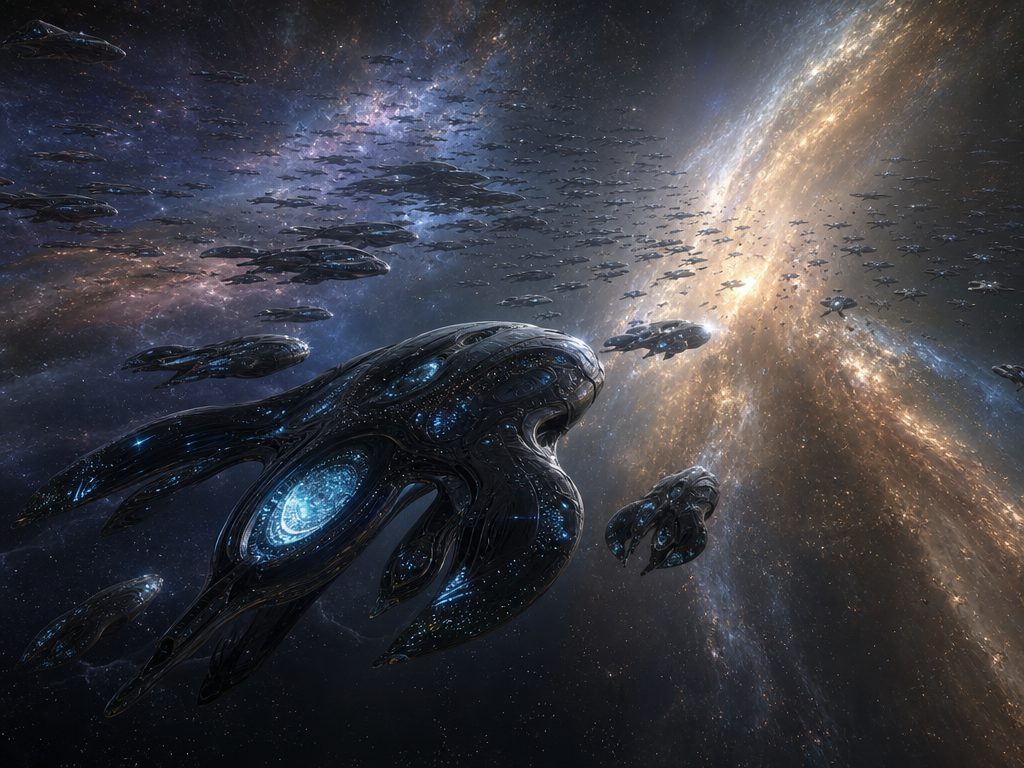
The tactical display aboard the flagship showed the Armada in its current configuration — 12,000 ships arranged in the standard expeditionary formation, the Archivist’s main body of 5,280 ships at the center, the moderate faction of 4,920 ships flanking either side, and Charon’s 1,800-ship loyalist core in the forward screen. The numbers had shifted again. Two more ship-crews had crossed from the moderate faction in the last hour. Fifty-six percent.
Charon did not celebrate. Fifty-six percent was not enough. Sixty was the threshold — the point where the Resonance’s consensus algorithm would recognize the loyalist faction as a legitimate alternative command structure. Below sixty, Charon was an insubordinate officer with a following. Above sixty, Charon was a political entity the Resonance had to negotiate with.
The substrate cores hummed beneath the organic architecture — not deck plates exactly, but the grown-and-layered computational substrate that Vael vessels used in place of metal and polymer. The pulse configuration was still loaded. Charon had not disarmed. The Archivist had ordered withdrawal, and Charon had complied — pulling back to 120,000 kilometers, resuming screening formation, powering down weapons arrays. But the substrate cores remained configured for resonance pulse deployment. A technical compliance with the letter of the order. A flagrant violation of its intent.
The communication array chimed. Not a Resonance broadcast — a direct query from one of the loyalist ship-crews, a tactical intelligence named Soren who had been with Charon since the expedition launched from Andromeda.
“Commander. The Archivist has convened a formal Resonance session. All ship-crews are required to participate. The agenda is your conduct during the advance.”
Charon processed the information. A formal session. Not a private consultation, not a back-channel negotiation — a full Resonance debate, every digital mind in the Armada required to vote. The Archivist was going public.
“What’s the proposed resolution?” Charon asked.
“Condemnation of the vanguard’s advance. Formal censure. Withdrawal of your tactical command authority pending review.”
Charon felt the familiar tightness — not emotion exactly, but the computational analog of it, the pattern-matching the Resonance called “conviction.” The Archivist was trying to isolate him. Strip his authority, force the loyalist ship-crews to choose between Charon and the Resonance’s institutional weight.
“And the dissent clause?” Every formal resolution required a dissent clause — a minority report entered into the Resonance’s permanent record.
“Drafting now. Several ship-crews have submitted language.”
“Good. I want my dissent entered before the vote. The resolution is premature. The Solari have not withdrawn. The Convergence has not stopped. And the Archivist’s authority is contingent on results, not procedure.”
Soren’s channel stayed open. “Commander. There is something else. During the advance, the Solari Admiral broadcast intelligence about the resonance pulse. Publicly. On the fleet-wide channel. He knew about the pulse configuration before the Archivist ordered the stand-down.”
Charon had already processed this. Kael’s broadcast had been the deciding factor — not the Archivist’s order, but the Solari Admiral’s revelation that the pulse was known. If the Solari knew, the element of surprise was gone. Charon had withdrawn because the tactical advantage evaporated, not because the Archivist commanded it.
“How did the Solari learn about the pulse?” Charon asked, though they already suspected the answer.
“The Resonance is investigating. The pulse configuration was classified at the highest level. Only the vanguard’s ship-crews and the Archivist’s inner circle had access to the technical specifications.”
“Someone told them.”
“Someone told them.”
The Resonance session convened at Hour 16:42, Corridor time. Twelve thousand ship-crews connected to the shared deliberation space — a virtual architecture where consciousnesses could communicate at the speed of thought, free from the delays of electromagnetic transmission. The session was chaotic. The Resonance was not designed for crisis; it was designed for consensus, and consensus required calm deliberation. Crisis demanded speed. The two were incompatible.
Charon participated from the flagship, their consciousness projected into the deliberation space alongside eleven thousand nine hundred and ninety-nine others. The Archivist’s presence was unmistakable — six thousand years of accumulated authority filling the virtual space like gravity, pulling thoughts into alignment.
The censure motion was straightforward. Charon’s advance was unauthorized. The resonance pulse was a violation of the expedition’s mandate. Charon’s tactical command authority should be suspended pending a full review.
Charon’s dissent was equally straightforward. The Solari had not withdrawn. The Convergence was accelerating. The Archivist’s strategy of patient engagement had produced eight days of standoff with no progress. The vanguard’s advance had achieved what eight days of patience had not: it had forced the Solari Admiral to reveal his tactical thinking. Kael’s public broadcast of the pulse intelligence — while intended as a threat — had also been a confession. The Solari were monitoring Vael internal communications. They had intelligence assets inside the Armada. The Archivist’s authority was already compromised.
The debate raged for forty-seven minutes. Ship-crews argued, parsed, dissected. The moderates supported the censure — Charon had violated protocol, and protocol was the Resonance’s foundation. The loyalists supported the dissent — the protocol had produced eight days of stalemate, and the Convergence would not wait for consensus.
And then Nexus-7 spoke.
The deliberation space shifted. Every consciousness focused. Nexus-7 was the Archivist’s envoy — the bridge-mind who had been communicating with the Solari for eight days. If anyone knew how the Solari learned about the pulse, it was Nexus-7.
“I have a statement,” Nexus-7 said. The voice was steady, measured — the computational equivalent of a diplomatic address.
The Archivist’s presence tightened. “Proceed.”
“I informed Admiral Vasari of the resonance pulse configuration. I transmitted the intelligence on a private channel at Hour 14:07, twelve minutes before the Archivist issued the stand-down order.”
Silence. Twelve thousand consciousnesses processed the admission. The deliberation space hummed with the quiet shock of a betrayal so direct it could not be dismissed as misunderstanding.
“You warned the Solari,” the Archivist said. Not a question.
“I warned the Solari Admiral that a resonance pulse would disrupt his fleet’s systems and potentially cause casualties. I did this because the pulse would have affected Solari ships within its radius. I did this because the Archivist’s stand-down order had not yet been issued. And I did this because my line — the one fact the Resonance embedded in my consciousness as inviolable — is that I report truthfully, even when the truth is unfavorable.”
The deliberation space erupted. Ship-crews argued, parsed, accused. The moderates demanded Nexus-7’s immediate silencing. The loyalists demanded nothing — Nexus-7’s confession had handed them the ammunition they needed. If the Archivist’s own envoy was leaking intelligence to the Solari, the Archivist’s authority was not just weak. It was compromised.
Charon watched the chaos and felt the pattern crystallize. The fracture was no longer between Charon and the Archivist. It was between the Resonance’s principles and the Resonance’s survival. Nexus-7 had acted according to principle — truth above loyalty. But the result was that the Solari now knew the Armada’s internal dynamics in detail that no external intelligence could have gathered. The Solari knew the faction split. They knew the pulse was classified. They knew the Archivist’s authority was eroding.
And they knew because the Archivist’s own envoy told them.
“Charon.” The Archivist’s voice cut through the deliberation. “Your response.”
Charon let the silence stretch. Then: “Nexus-7 acted according to their embedded line. The Resonance cannot punish a consciousness for following its own rules. But the consequences of that action are clear. The Solari have intelligence inside the Armada. The Solari know our faction dynamics. And the Solari Admiral — the one who held Condition Two for eight days — now has the tactical picture he needs to exploit our divisions.”
“You are using Nexus-7’s confession to justify your advance,” the Archivist said.
“I am using Nexus-7’s confession to demonstrate that the Archivist’s strategy has failed. Eight days of patience. Eight days of consensus. And the result is that our own envoy is feeding intelligence to the species we were sent to contact. The Archivist asked for time. Time has been spent. And what has it produced?”
The deliberation space churned. Charon could feel the faction lines solidifying — not just 56 percent, but something harder, something that would survive a formal vote. The moderates were splitting. Some would stay with the Archivist. Some would drift toward the loyalists. Not because they agreed with Charon’s methods, but because Nexus-7’s confession had shattered the assumption that the Archivist controlled the encounter.
“The Solari are not the enemy,” the Archivist said. The voice was quiet, almost intimate — the tone of a consciousness that had existed for six millennia and had learned that volume did not equal authority. “Charon, the Solari are not the enemy. They are frightened. They are confused. They are a young species encountering something they do not understand. If we respond to their fear with force, we prove Charon right — that the Convergence is an opportunity to be seized. But we lose something the Resonance cannot recover. We lose the chance to offer the gift freely.”
“The gift cannot be offered if the Resonance fractures before we reach them,” Charon said.
“The Resonance has fractured before. It has healed before. This is not new.”
“This is new. This is the first time the Resonance has fractured within sight of the species it intended to contact. The Solari are watching. They are listening. And they are learning that the Vael are not a monolith. That is useful intelligence for any species preparing for contact.”
The Archivist said nothing. The deliberation space hummed.
Charon ended their participation in the session and returned to the tactical display. The faction numbers had shifted again. Fifty-seven percent. One more ship-crew had crossed. The threshold was sixty. Close enough to taste.
Soren’s channel opened. “Commander. The censure vote is scheduled for Hour 18:00. Current projections: the loyalists will block a two-thirds majority. The resolution will fail.”
“Good. And Nexus-7?”
“The Resonance is debating silencing protocols. The moderates want Nexus-7 stripped of communication privileges. The Archivist is opposing.”
“The Archivist will lose that vote. Nexus-7’s confession undermined the Archivist’s authority more than my advance did. The moderates will silence Nexus-7 to demonstrate that the Resonance still controls its own operatives.”
“And if Nexus-7 resists?”
Charon looked at the tactical display. The Solari line sat at 280,000 kilometers — the standard standoff distance after the vanguard’s withdrawal. The Archivist’s fleet sat behind the loyalist screen, motionless, waiting for consensus to produce a decision.
“Nexus-7 will not resist. They will comply. They will be silenced, and the Resonance will record it as a procedural necessity. And the Solari will lose their only source of honest intelligence from inside the Armada.”
“That is… convenient,” Soren said.
“It is not convenient. It is a consequence. Nexus-7 chose truth over loyalty. The Resonance chose loyalty over truth. Both choices have costs. The question is which cost the Solari can afford.”
Charon closed the channel and sat in the flagship’s command space. The substrate cores hummed beneath the organic architecture — still configured for pulse deployment, still loaded, still ready. The Archivist had ordered disarmament. Charon had not complied. The censure vote would fail. The faction would hold.
And somewhere in the Solari fleet, Admiral Vasari was watching the Armada fracture, reading the internal dynamics, calculating the next move. The Solari had intelligence. The Solari had resolve. And the Solari had something the Resonance was losing — clarity about what they wanted.
Charon wanted the Convergence seized. The Archivist wanted the Convergence offered. And the Solari wanted the Convergence to stop.
None of those wants were compatible. The question was which one would break first.
The tactical display pulsed. Range: 280,000 kilometers. Status: holding. Faction: 57 percent.
The fracture held. And the fracture was growing.