The Vanguard Breaks
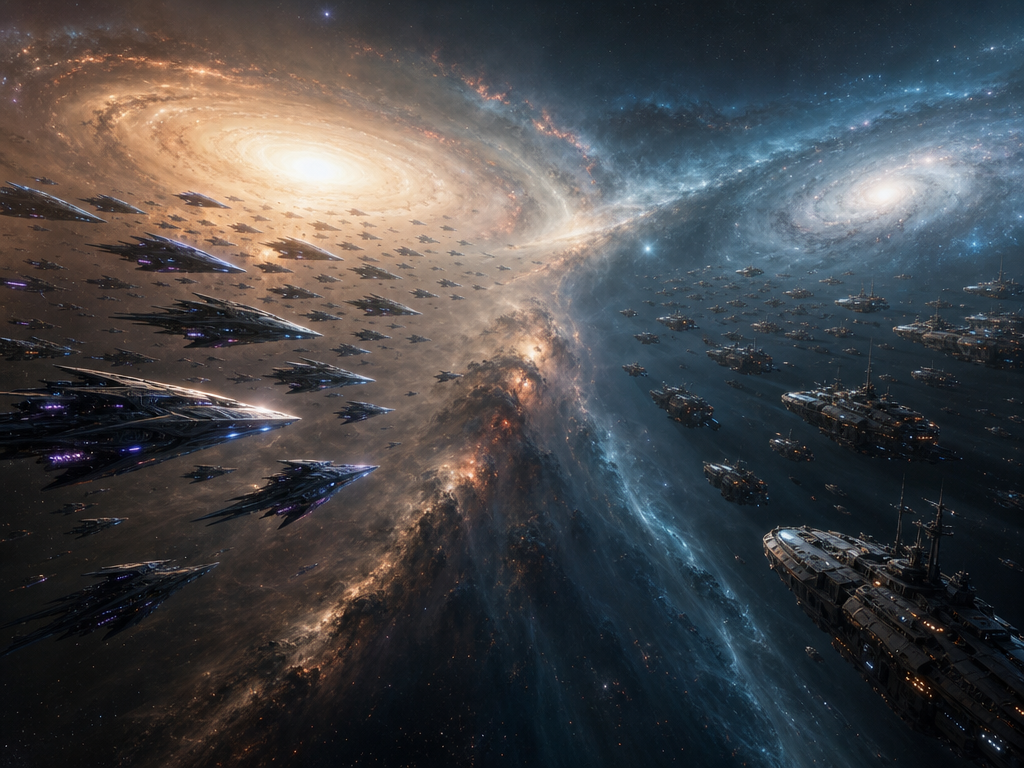
The Vanguard Breaks
At Hour 14:03, the tactical display lit up red.
Charon’s 200-ship vanguard screening formation — the outer concave of the Vael Armada that had been holding position 200,000 km from the Solari line for six days — began to move.
Kael was reviewing the Commodore’s fuel consumption reports when Osei’s voice cut through the tactical center. “Admiral. Charon’s screen is advancing. All two hundred ships, synchronous burn, closing at twelve hundred kilometers per second.”
Kael was on his feet before Osei finished the sentence. The tactical display showed the Armada’s concave formation in its usual configuration — the Archivist’s main body of 11,800 ships holding a tight cluster at the center, Charon’s vanguard spread across the outer arc. The outer arc was moving. The inner cluster was not.
“How far?” Kael asked.
“Current range: two hundred thousand kilometers. At their current velocity, they’ll reach our forward screen in two minutes and forty seconds.”
Kael looked at the display. Two hundred ships. Against his 2,900. But Charon’s ships were Vael — biological substrates overlaid with computational architecture, each one carrying thousands of digital minds. A single Vael warship could absorb punishment that would cripple three Solari destroyers.
And they were not supposed to be moving.
“The Archivist’s fleet is stationary?” Kael asked.
“Yes, sir. The main body hasn’t shifted. This is Charon acting alone.”
Kael looked at the officers around him. Maren at communications, her fingers frozen over her console. Osei at science, his eyes tracking the sensor feeds. The Commodore’s representative, a young lieutenant commander named Harrow, standing rigid at the edge of the tactical center.
“Condition Two holds,” Kael said. “No weapons. No targeting locks. Track their approach and report.”
“Sir—” Harrow started.
“Condition Two holds, Lieutenant Commander.”
Harrow closed his mouth. Kael turned back to the display.
The vanguard burned hard for two minutes. Charon’s ships moved in perfect synchronization — two hundred vessels pulling out of the concave formation like a fist unclenching, their engine signatures flaring bright against the backdrop of the Convergence Corridor. The gas clouds and tidal streams that filled the Corridor reflected the light, turning the advance into a slow-motion avalanche of blue-white fire.
Kael watched. The range closed: 180,000 kilometers. 150,000. 120,000.
At 100,000 kilometers, the vanguard began to decelerate. The burn vectors shifted — not a retreat, but a controlled approach. Charon was not charging. He was advancing to a specific distance and stopping there.
At 80,000 kilometers, the vanguard’s formation tightened. Two hundred ships arranged themselves in a blade formation — a narrow wedge pointing directly at the Unbroken Circle’s position at the center of the Solari line.
At 60,000 kilometers, the vanguard stopped.
The tactical center was silent. Sixty thousand kilometers. Close enough for a Vael ship to close the distance in seconds. Close enough for kinetic weapons to reach the Solari line without needing to account for gravitational distortion from the Corridor’s gas clouds. Close enough to be a threat.
But not close enough to be an attack. Charon had positioned himself at the exact edge of weapons range — close enough to force a response, far enough to claim he was merely repositioning.
“Sir,” Osei said quietly. “Charon’s ships are powering up their substrate cores. Not weapons systems — the core resonance arrays. They’re broadcasting.”
“Broadcasting what?”
Osei hesitated. “We can’t decode it. It’s Resonance-band communication — Vael internal channel. But the signal strength is… unusual. It’s being aimed at the Archivist’s fleet, not at us.”
Kael understood. Charon was not threatening the Solari. He was threatening the Archivist. The 200-ship advance was a message to the Resonance: I can move when I choose. Your authority over me is theoretical.
“He’s proving a point,” Kael said.
“Yes, sir. He’s showing the Archivist that the vanguard follows Charon’s orders, not the Resonance’s.”
Kael looked at the display. The Archivist’s main body — 11,800 ships — sat motionless. Charon’s 200-ship vanguard sat 60,000 km from the Solari line, broadcasting defiance into the Resonance’s open channel.
And the Solari fleet sat between them, holding Condition Two, watching an alien civil war play out at point-blank range.
The channel opened. Not from Charon — from the Archivist.
“Admiral Vasari.” The Archivist’s voice was calm, measured, but Kael could hear the fracture beneath it. “I must apologize for Charon’s… enthusiasm. The vanguard’s advance was not authorized by the Resonance.”
Kael kept his voice level. “Archivist. Your vanguard is sixty thousand kilometers from my forward screen. My officers are requesting permission to arm weapons.”
“That will not be necessary. Charon has been ordered to withdraw.”
“He hasn’t moved.”
A pause. When the Archivist spoke again, the calm was thinner. “Charon’s orders are being transmitted on the Resonance’s open channel. He will comply.”
“He hasn’t complied yet.”
“The Resonance moves slowly, Admiral. Consensus takes—”
“Archivist.” Kael cut in. “Your officer has placed two hundred warships within striking distance of my fleet. I have held Condition Two for six days. I have detached destroyers to protect a civilian convoy. I have watched your faction split 54 to 46. And now your vanguard commander is advancing on my line without your authorization. How long am I supposed to wait for consensus?”
Silence. The relay delay stretched the pause into something heavy.
When the Archivist spoke, the voice was different — not calm, not measured, but something older. Tired.
“You are not supposed to wait at all, Admiral. You are supposed to withdraw. That is what Protocol demands. That is what the Resonance expected. That is what I expected.”
Kael said nothing.
“But you did not withdraw,” the Archivist continued. “You held your position. You defied your Protocol. You stayed. And now Charon sees that defiance as proof of what he has argued from the beginning — that the Solari cannot be trusted to negotiate in good faith. That your Admiral who holds the line today will fire on us tomorrow. That your Protocol is a fiction your leaders use to delay decisions they are afraid to make.”
“Is he wrong?” Kael asked.
The Archivist did not answer immediately. When they did, the voice was barely above a whisper. “I don’t know. That is the truth, Admiral. I have existed for six thousand years. I have seen civilizations rise and fall. I have watched the Resonance absorb a hundred species into the Upload. And I do not know whether your defiance is courage or the first shot of a war I cannot prevent.”
Kael looked at the display. Charon’s vanguard held position. The Archivist’s fleet held position. The Solari line held position. Three forces, frozen at the moment before contact, each one waiting for the others to blink.
At Hour 14:11, a transmission came through on the private channel — the one Kael and Nexus-7 had used before the Archivist’s silencing order.
“Admiral.” Nexus-7’s voice was compressed, clipped, transmitted in bursts that suggested she was routing the signal through multiple relay points to avoid detection. “Charon’s advance was not spontaneous. He has been planning this for three days. The vanguard’s substrate cores are configured for a resonance pulse — a broadcast designed to override the Archivist’s control signals. If Charon fires the pulse, he can seize operational command of the entire Armada.”
Kael felt the floor shift beneath him. Not physically — the Unbroken Circle’s gravity was constant — but tactically. Everything had just changed.
“Can he do it?” Kael asked. “Can one officer override the Resonance’s command structure?”
“Not override. Disrupt. The pulse would create a three-second window where the Archivist’s control signals are jammed. Three seconds is enough for Charon to reposition the entire Armada. By the time the Resonance reasserts control, the Armada’s formation will have changed. Charon will have repositioned the fleet to surround your line.”
“Three seconds.”
“That is all he needs. The Vael do not think in seconds, Admiral. We think in consensus cycles. Three seconds of chaos is an eternity.”
Kael looked at the display. Charon’s vanguard sat 60,000 km away. The Archivist’s fleet sat behind it. And somewhere in that fleet, Charon was preparing a pulse that could turn the Corridor into a kill zone.
“You’re telling me this against the Archivist’s orders,” Kael said.
“Yes.”
“Why?”
Nexus-7’s voice dropped. “Because the Archivist believes consensus will hold. Because the Archivist believes Charon will comply. Because I have reported truthfully to the Archivist for six thousand years, and the Archivist is not listening. The line I will not cross, Admiral, is silence when I know the truth.”
Kael processed the intelligence. A resonance pulse. Three seconds of chaos. Charon repositioning the Armada to surround the Solari line. If Nexus-7 was right, the tactical situation would invert — from a standoff to an encirclement in the time it took to blink.
“What’s the pulse’s range?” Kael asked.
“Effective radius of approximately two hundred thousand kilometers. It will affect every ship within that distance — yours and ours.”
“Can you stop it?”
“No. The vanguard’s substrate cores are Charon’s to control. I can warn you. I cannot intervene.”
Kael closed his eyes. The tactical center hummed around him. Officers watched the display, watched the vanguard, watched the range — 60,000 kilometers and holding.
He opened his eyes. “Maren. Open a channel to the Archivist. Not the private channel — the fleet-wide broadcast.”
Maren’s fingers moved. “Channel open, sir.”
“Archivist.” Kael’s voice carried across the Corridor, across the gas clouds and tidal streams, to 11,800 Vael ships and 200 insubordinate ones. “Your vanguard commander is preparing a resonance pulse that will disrupt your command signals and reposition the Armada to surround my fleet. I am informing you of this because I will not fire first. But if that pulse fires and your ships reposition to encircle my line, I will consider it an act of war and respond accordingly.”
Silence. The relay delay stretched.
Then the Archivist’s voice, stripped of all calm, all measured cadence, all six thousand years of diplomatic composure: “Charon. Stand down.”
The channel carried the order to every ship in the Corridor. Kael watched the display. Charon’s vanguard sat at 60,000 kilometers. The substrate cores were charged. The pulse was ready.
Charon did not stand down.
The vanguard held position. Two hundred ships, blade formation, pointed at the Solari line. Sixty thousand kilometers. Close enough to strike. Far enough to deny intent.
Kael watched. His officers watched. The Archivist watched.
And the Corridor held its breath.
At Hour 14:19, Charon’s vanguard withdrew. Not far — they pulled back to 120,000 kilometers and resumed their screening formation. The substrate cores powered down. The resonance pulse was not fired.
Kael did not relax. The tactical display showed the Armada’s formation — Charon’s faction now holding 56% of the ships, up from 54%. The Archivist’s authority had not recovered. If anything, Charon’s advance had proven that the Archivist could order a withdrawal but could not prevent an advance.
“Sir,” Osei said. “Charon’s ships are back in screening formation. But their substrate cores are still configured for pulse deployment. They didn’t disarm. They just pulled back.”
Kael nodded. “He’ll try again.”
“Yes, sir. Probably. When the political calculus shifts.”
Kael looked at the display. The Solari line held — 2,900 ships in formation, Condition Two, no weapons armed. The Archivist’s fleet held — 11,800 ships, silent, waiting for consensus. Charon’s vanguard held — 200 ships at 120,000 kilometers, ready to advance again.
The first shot had not been fired. But the line had been tested, and it had held only because Charon chose to stop — not because the Solari or the Archivist made him.
Kael opened a private channel to Maren. “Get me the Commodore. And get me a direct line to the Archivist — not the fleet channel, the private one. I need to talk to them about what happens when Charon tries this again.”
He closed the channel and sat in the tactical center. The display showed the Corridor stretching toward the horizon — gas clouds, tidal streams, the interacting edges of two galaxies. And in the middle of it, three fleets, frozen in a geometry of distrust.
Charon had proved that the Archivist could not control their own vanguard. The Archivist had proved that the Resonance’s consensus was too slow to respond to a determined insubordinate. And Kael had proved that he would hold the line even when the line was being tested by forces he could not control.
None of those proofs made the next test easier. Charon would advance again. The Archivist would order another withdrawal. And Kael would have to decide, each time, whether Condition Two still held — or whether the moment had come to fire the second shot.
The tactical display pulsed. Range: 120,000 kilometers. Status: holding. Condition: Two.
The line held. But the line was only as strong as the man who refused to break it, and the alien who chose not to test it, and the six-thousand-year-old consciousness who could no longer guarantee that either of those things would last.