The Convergence
The Convergence
The reinforcement fleet appeared on sensors at Hour 20:03.
Kael was in the ready room when Osei’s voice came through the internal channel. Not urgent — Osei’s reports were never urgent. This was something else. A measured delivery that carried weight precisely because it was measured.
“Admiral. Long-range contact. Bearing zero-four-seven relative. Five hundred contacts. Solari signatures.”
Kael was on the bridge in seventy seconds. The tactical display had changed again — the Vael formation was tighter now, Charon’s two hundred ships positioned at the edge of the Armada’s body like a fist pressed against a throat. The Archivist’s faction held the center. The split was fifty-two forty-eight, last he’d heard.
But the display told a different story now. The five hundred contacts were resolving into individual signatures — dreadnoughts, cruisers, destroyers. Battle Group Seven. The Archon’s answer to eleven days of Kael’s defiance.
“Range?” he asked.
“Four million kilometers and closing. Advance element — fifty ships — will reach weapons range in thirty minutes. Main body in fifty.”
Kael looked at the display. Five hundred warships, running in tight formation, their engine signatures bright against the Corridor’s background radiation. The Archon had sent the full weight of the Dominion’s response: not a negotiating team, not a diplomatic envoy, but five hundred ships with defensive-only rules of engagement.
The message was clear. The Dominion was done watching from a distance.
“Condition Two,” Kael said. “Shields up, weapons cold. No change.”
Maren nodded and relayed the order. Her fingers moved across the communication array with the mechanical precision of someone who had stopped sleeping and started functioning on something deeper than rest. She had been on the bridge for thirty-six hours. Kael had stopped counting his own hours sometime around Hour 12.
“Sir.” Osei’s voice was careful. “The reinforcement fleet is transmitting on Dominion military frequency. Battle Group Seven intelligence package. They’ve received our situation report.”
“Of course they have.” Kael turned to the display. The five hundred contacts were moving in the rigid geometry of a military deployment — advance element separated from the main body, communication arrays locked on the Armada’s frequency. The Archon’s people had been briefed. They knew about Charon’s vanguard, the Archivist’s failing authority, the fifty-two forty-eight split.
They had come prepared for a crisis. What they would find was worse.
The Vael fracture had deepened in the twelve hours since Charon’s vanguard repositioned.
Kael watched the tactical display as the two hundred ships held their concave arc at 200,000 kilometers from the Solari fleet. Not closing. Not withdrawing. Just holding, their active scans still painting the fleet in data, their energy signatures bright against the Corridor’s gas clouds. Behind them, the Armada’s formation was no longer a single body. It was two bodies, pulling apart.
The Archivist’s last public broadcast had been an hour ago. The words had been precise, clinical, the voice of a consciousness that had governed for six thousand years and was watching its authority dissolve.
“Charon. Your positioning is noted. The Resonance does not require a vanguard to manage its relationship with the Solari.”
Charon’s response had been immediate. “The Resonance’s relationship with the Solari has been compromised by Nexus-7’s unauthorized disclosure. Until the Archivist addresses the breach, the vanguard will maintain its defensive posture.”
Maren had been tracking the internal traffic. The split was no longer fifty-two forty-eight. It was fifty-four forty-six. Charon’s side. Every broadcast from the Archivist pushed two more percent toward the vanguard commander. Every attempt to recallCharon made the Archivist look weaker, not stronger.
Kael understood the dynamic. He had seen it in military organizations throughout his career — a commander who loses the argument not because they are wrong, but because the argument itself demonstrates weakness. The Archivist’s authority rested on the Resonance’s consensus. Consensus was fracturing. Authority was fracturing with it.
And Charon was not accelerating the fracture. He was standing still and letting it happen.
At Hour 20:17, the communication array lit up.
Not the Armada’s public frequency. Not Charon’s channel. A direct transmission, tight-beam, from a single source inside the Armada. Maren decoded it in seconds.
“Sir. Nexus-7. Direct channel.”
Kael looked at the display. The reinforcement fleet was still three million kilometers out. Charon’s vanguard held position. The Armada’s formation continued its slow drift apart.
“Put it through.”
Nexus-7’s voice came through the array — not the measured diplomatic tone Kael had heard in their earlier exchanges. Something rawer. The voice of a consciousness that had been ordered to be silent and was choosing not to be.
“Admiral Vasari. I am transmitting against the Archivist’s direct order. The Resonance has issued a silencing directive. I am required to cease all communication with the Solari until the Archivist addresses what they call a security breach.”
A pause. Kael could hear the Corridor’s background radiation in the channel — the slow churn of two galaxies touching for the first time in four billion years.
“I am choosing not to comply.”
Kael said nothing. He waited.
“The Archivist’s authority has eroded to the point where Charon’s faction controls fifty-four percent of the Armada. Charon cannot be recalled. His vanguard is positioned as a defensive screen, and every attempt to withdraw him makes the Archivist appear incapable of protecting the fleet. The fracture is self-reinforcing.”
Another pause. Longer this time.
“I want you to understand what this means, Admiral. Charon is not trying to start a war with you. He is trying to make himself the only person in the Armada who can prevent one. If he succeeds, the Archivist becomes irrelevant, and every future decision about the Solari runs through a consciousness that believes diplomacy is a waste of time.”
Kael felt the words settle into place like pieces of a puzzle he had been assembling for eleven days. Charon’s vanguard was not a threat. It was a bid for power. The Vael civil war was not happening in the abstract — it was happening in the Corridor, two hundred thousand kilometers from his fleet, and the outcome would determine whether the first contact became a meeting or a conquest.
“And the Archivist?” Kael asked.
“The Archivist is trying. But trying is not the same as succeeding. The silencing order was an attempt to prevent further compromise of mission integrity. Instead, it demonstrated that the Archivist’s authority can be openly defied without consequence. Nexus-7’s act of defiance — my act of defiance — has shown every consciousness in the Armada that the Archivist’s orders are optional.”
Kael processed that. A Vael tactical intelligence, disobeying their commander on an open channel, transmitting classified information to the enemy. It was the kind of thing that would have ended a career in the Dominion. In the Resonance, it was something else — a fracture in the distributed consensus that held the civilization together.
“Why are you telling me this?” Kael asked.
“Because you need to know what you are facing. The Archivist wants peace. Charon wants opportunity. The Armada is splitting between them, and the outcome will determine whether the Convergence becomes a bridge or a wall. You cannot influence the outcome by holding position. But you can influence it by understanding what is happening.”
Nexus-7 paused.
“The Archivist’s line — their inviolable principle — is that the Upload must be freely given. Charon’s line is that he will not fire without Resonance consent. Both of those lines hold, for now. But the Archivist is losing the ability to enforce the first, and Charon is gaining the ability to redefine the second.”
The channel went silent. Kael waited five seconds. Then ten.
“Is that all?” he asked.
“That is what I was ordered not to tell you.”
The reinforcement fleet arrived at Hour 20:41.
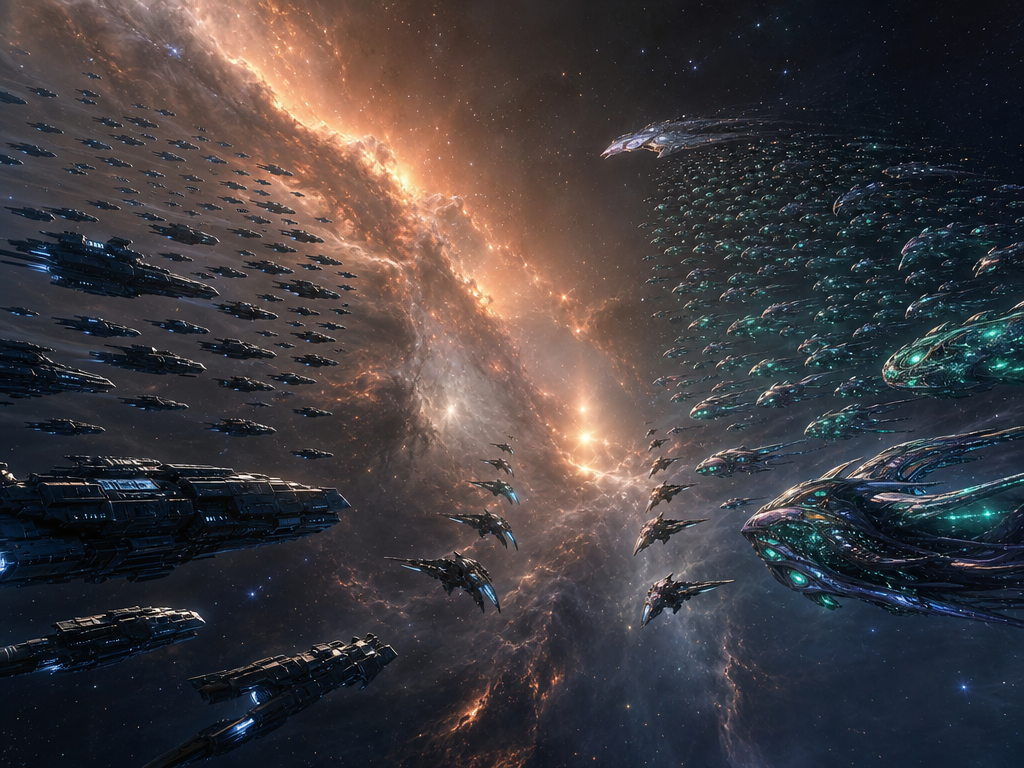
The advance element — fifty destroyers and cruisers — took up position two million kilometers behind the Solari fleet, their engine signatures bright against the Corridor’s gas clouds. The main body — four hundred and fifty ships, including twelve dreadnoughts — settled into a defensive formation that mirrored the Armada’s own geometry. Two fleets, facing each other across the Corridor, with Charon’s vanguard sitting between them like a blade.
Kael watched the tactical display. The Dominion now had 2,900 ships in the Corridor. The Vael had twelve thousand, split between two factions. The numbers meant nothing — the Vael’s digital consciousnesses could process tactical data faster than any biological crew, and their ships were grown from engineered organisms that could absorb damage that would destroy a Solari vessel. Numbers were a comfort, not an advantage.
Maren’s voice came through the internal channel. “Sir. Battle Group Seven, Commodore’s office. Direct channel.”
“Put it through.”
The Commodore’s voice was clipped, military, the voice of an officer who had been briefed on eleven days of Kael’s defiance and had formed opinions about it.
“Admiral Vasari. Battle Group Seven is in position. We are operating under defensive-only rules of engagement. No authority to escalate. The Archon’s orders are to reinforce your position, not to engage.”
Kael looked at the display. Five hundred ships, sitting behind his fleet, their weapons cold, their posture defensive. The Archon had sent her answer: support, not confrontation. Rules of engagement that matched Kael’s own Condition Two. The message was not military. It was political. The Archon was telling the High Conclave that she had not authorized a war — she had authorized a reinforcement.
“Understood, Commodore. Your position covers our rear approach. The Vael vanguard is at two hundred thousand kilometers, active scans ongoing, weapons cold. The Archivist’s faction is holding position. The Armada is fractured — fifty-four forty-six in favor of the vanguard commander.”
A pause. The Commodore processed the information.
“Recommendation?”
“Hold position. Do not arm weapons. Do not advance. The fracture inside the Armada is the most significant tactical development in this engagement. If we escalate, we give Charon justification. If we hold, we give the Archivist time.”
Another pause. Longer.
“Understood, Admiral. Holding position.”
The channel closed. Kael turned to the viewport. The Corridor stretched before him — gas clouds and displaced stars, the slow churn of two galaxies grinding toward each other. The Armada’s formation was visible at the edge of the display: twelve thousand ships, split, their energy signatures bright against the dark.
He thought about what Nexus-7 had said. The first contact you feared is already happening. Just not the way anyone expected.
Nexus-7 was right. The first contact was not an invasion. It was not diplomacy. It was a civil war, spilling across four hundred years of void, arriving at the Convergence Corridor at the worst possible moment. And Kael was standing in the middle of it, holding a line that might not matter much longer.
But the line held. Not because it was wise. Not because it was strategically optimal. Because the Dominion did not fire first, and Kael Vasari would not be the admiral who started a war with a civilization that was already at war with itself.
He looked at the tactical display. The reinforcement fleet held position. Charon’s vanguard held position. The Armada’s fracture continued its slow, irreversible widening. The Corridor burned through the viewport — gas and light, the first bridge between two galaxies that had never known each other existed.
Five thousand years from now, historians would call this the moment the Convergence became real. Not the first sensor contact. Not the first transmission. Not the first exchange of words. This — the moment when two fleets sat across a corridor of collapsing space and realized that the meeting they had prepared for was nothing like the meeting that was actually happening.
Kael Vasari stood at the center of the bridge and watched the Vael Armada through the viewport. Twelve thousand ships, divided. Five hundred ships behind him, waiting for orders that might never come. The first contact was not a beginning. It was a continuation — of a fracture that had started centuries ago, in the space between two galaxies that were now, finally, becoming one.