The Passing
The Passing
Twenty hours since Meridian went dark. The freighter Meridian’s Fortune held course at 0.12c, its hull running hot from continuous burn. Belowdecks, twelve hundred people slept in shifts on the cargo hold floor, their bodies pressed together for warmth in a space designed for mineral containers. The life support recyclers were at 94% — Tobin had been nursing them there for sixteen hours, diverting power from nonessential systems to keep the air breathable.
Dara stood in the bridge of the lead transport Haven, watching the navigation display. The convoy stretched behind her in a loose formation, seventeen ships with engine signatures bright against the dark. Harken’s Landing was four hours out. Four more hours of recycled air and crowded holds and the particular exhaustion of people who had left everything behind and had nothing to do but wait.
Tobin’s voice came through the internal comm. “Warden. Long-range sensors. Something behind us.”
Dara turned to the tactical display. The sensor feed was degraded — the transport’s arrays were military surplus, twenty years old, designed for asteroid tracking. But the signature was unmistakable. Energy output. Massive. Moving at high burn. Closing fast.
“How many?” she asked.
“Five hundred. Give or take. Resolution isn’t good enough to count precisely, but the energy profile matches a Solari battle group. Heavy ships. Dreadnought-class signatures.”
Dara felt her stomach tighten. The Archon’s reinforcement fleet. Five hundred warships heading for the Corridor. And heading directly toward her convoy.
Tobin pulled up the tactical feed on the bridge’s main screen. The contacts were still distant — four million kilometers and closing — but their formation was visible even at this range. A tight cluster of energy signatures, moving in the rigid geometry of a military deployment. The advance element was separate from the main body: fifty ships running ahead of the formation, their engines burning hot.
“Advance element will reach us in forty minutes at current closure rate,” Tobin said. “Main body in seventy.”
“Are they on an intercept course?”
Tobin checked the navigation data. His fingers moved across the console with the same methodical precision he applied to relay gate diagnostics — measuring, calculating, reporting exactly what he found. “Not intercept. Our trajectory and theirs cross within two million kilometers. They’ll pass us, not meet us. But the advance element will have sensor contact in twenty minutes.”
Dara looked at the display. Fifty warships. The largest Solari military deployment she had ever seen, and it was passing within spitting distance of seventeen overloaded freighters carrying twelve thousand miners and their children.
“Can they see us?”
“Our engine signatures are visible at this range. They’ll know we’re here.”
“Then they’ll contact us.”
“Likely.”
Dara thought about it. The convoy was civilian. No military transponder, no fleet identification. Just seventeen ships running from a dead colony toward the nearest port, their holds packed with people who had never held a weapon. If the advance element misidentified them — if someone in the formation’s tactical center read the engine signatures as unknown contacts and escalated to defensive posture —
“Open a channel on the Dominion military frequency,” Dara said. “Broadcast our identification. Meridian Colony evacuation convoy, Warden Dara commanding, en route to Harken’s Landing. Civilian. Non-combatant.”
Tobin nodded and set the transmission. The convoy’s communication array was weak — a fraction of what a military vessel carried — but the advance element was close enough to pick it up.
The response came in eight minutes. Not a voice. A data burst — compressed, encrypted, military-grade. Tobin decoded it on his tablet and read the summary aloud.
“Reinforcement Battle Group Seven, Commodore’s office. Acknowledged Meridian Colony convoy. Your identification is confirmed. Proceed to Harken’s Landing on current heading. Our transit will not interfere with your route.”
A pause. Tobin scrolled through the data package.
“There’s more. Intelligence summary. Corridor situation as of Day 7, Hour 06.” He looked up. “It’s detailed. Fleet dispositions, Vael movement, the Archon’s rules of engagement. They’re sending us the full picture.”
Dara stared at the screen. The advance element was still twenty minutes away, but the data was already here — flowing through the convoy’s weak communication array in a compressed burst that Tobin was decrypting line by line.
“Read it,” she said.
Tobin read the summary in the flat, precise voice he used for system diagnostics. No inflection. No commentary. Just the facts, delivered the way he delivered everything: exactly as measured, nothing added.
Kael’s fleet was holding position in the Convergence Corridor. Condition Two. Shields up, weapons cold. The Vael Armada was fractured — Charon’s vanguard had detached two hundred ships and positioned them at the edge of weapons range. The Archivist was losing authority. The split was fifty-two forty-eight in Charon’s favor.
The Archon had authorized a reinforcement fleet. Battle Group Seven. Five hundred ships with defensive-only rules of engagement. No authority to escalate. Their mission was to reinforce Kael’s position, not to engage.
And then the data that stopped Dara cold.
“Meridian Colony sensor data was received by the Vanguard Fleet at Day 6, Hour 20,” Tobin read. “The scout ship’s full sensor profile — bearing, speed, energy output, approach vector — was incorporated into the fleet’s tactical picture. The profile matched Charon’s vanguard signature, confirming that the detached Vael formation was composed of Charon’s screening force. Without Meridian’s data, the fleet would have lacked the sensor baseline to distinguish Charon’s ships from the Archivist’s main body.”
Silence on the bridge. The navigation display showed the advance element still closing. Twenty minutes.
Dara processed the words. Meridian’s data — captured by Tobin’s civilian sensors, transmitted through a mining colony’s relay gate before it died — had given Kael the ability to identify Charon’s vanguard. Without that data, the fleet would have seen twelve thousand ships as a single mass. With it, they could distinguish the two hundred that mattered from the eleven thousand eight hundred that didn’t.
Her colony’s miners had just provided the military intelligence that changed the Corridor’s tactical picture.
“The data package also includes a personal note,” Tobin said. His voice was still flat, but Dara heard something beneath it. Not pride. Something closer to disbelief. “From Lieutenant Commander Maren, communications officer, Unbroken Circle.”
“What does it say?”
Tobin read it. “‘Warden Dara — your relay transmission was the cleanest Vael sensor profile we’ve received. The scout’s energy signature gave us the baseline we needed to track Charon’s vanguard. Your people did more in twenty minutes of transmission than our intelligence division managed in seven days. The Admiral sends his thanks. Hold your course. Help is on the way.’”
Dara read the words on the screen. Your people did more in twenty minutes than our intelligence division managed in seven days. Twelve thousand miners on a dead moon, running overloaded freighters and improvised ventilation, had just outperformed the Dominion’s entire intelligence apparatus.
She thought about Tobin in the sensor bay, compiling the data package while the colony burned around him. About the relay gate running at full power, diagnostic systems offline, everything channeled into a single thirty-minute transmission. About the harbor crews releasing docking clamps by hand while the clock ran down.
They hadn’t been trying to change the Corridor’s tactical picture. They had been trying to survive. The intelligence was a byproduct of survival — a side effect of people doing what they always did, which was measure, transmit, and move.
“Receiving a second data burst,” Tobin said. “From the advance element’s sensor suite.”
He decoded it. This one was shorter. Tactical. A sensor contact report.
“The Vael scout that passed Meridian on Day 6,” Tobin said. “It’s been detected again. Dominion patrol vessel Steadfast, two hundred light-hours deeper into Milky Way space. The scout is maintaining its heading — away from the Corridor, away from the Armada, toward the relay network.”
Dara looked at the display. The advance element was fifteen minutes out. Their engine signatures were bright now, resolving into individual ships — destroyers and cruisers, their hulls reflecting the faint light of the Convergence Corridor’s distant burn.
“Toward the relay network?” she said. “Which relay?”
“Kessler Station. Primary relay hub for the outer disc. If the scout reaches it, it maps every relay-connected installation within two hundred light-years. Fort Halo, Harken’s Landing, every mining outpost and colonial station in the region.”
Dara felt the calculation click into place. The scout hadn’t been chasing Meridian. It had been mapping the relay infrastructure — using Meridian’s position as a reference point, then continuing deeper into Dominion space. Her colony was a waypoint on a survey route, not a target.
“The sensor profile we transmitted,” Dara said. “Is it complete enough to track the scout?”
“More than complete. The profile includes the scout’s full energy signature, approach vector, and acceleration pattern. Any Dominion sensor station with the data can identify the scout at range. But only if they have the data.” Tobin paused. “We’re the only source. The relay gate is dead. The transmission went to Fort Halo and Kael’s fleet. No one else has it.”
“Then we send it again.”
Tobin looked at her. “To whom? We have no relay gate. No fleet communication array. The advance element’s tight-beam is our only link.”
“Use it. Transmit the scout’s updated profile — everything we have, plus the Steadfast’s contact report — to the advance element. Let them relay it to Fort Halo and Kael’s fleet. Make sure every sensor station in the outer disc has the data before that scout reaches Kessler.”
Tobin’s fingers were already moving. “Compiling. The advance element is within tight-beam range — five million kilometers. Transmission will take twelve minutes to reach them.”
“Send it.”
The advance element passed them at Hour 17:04.
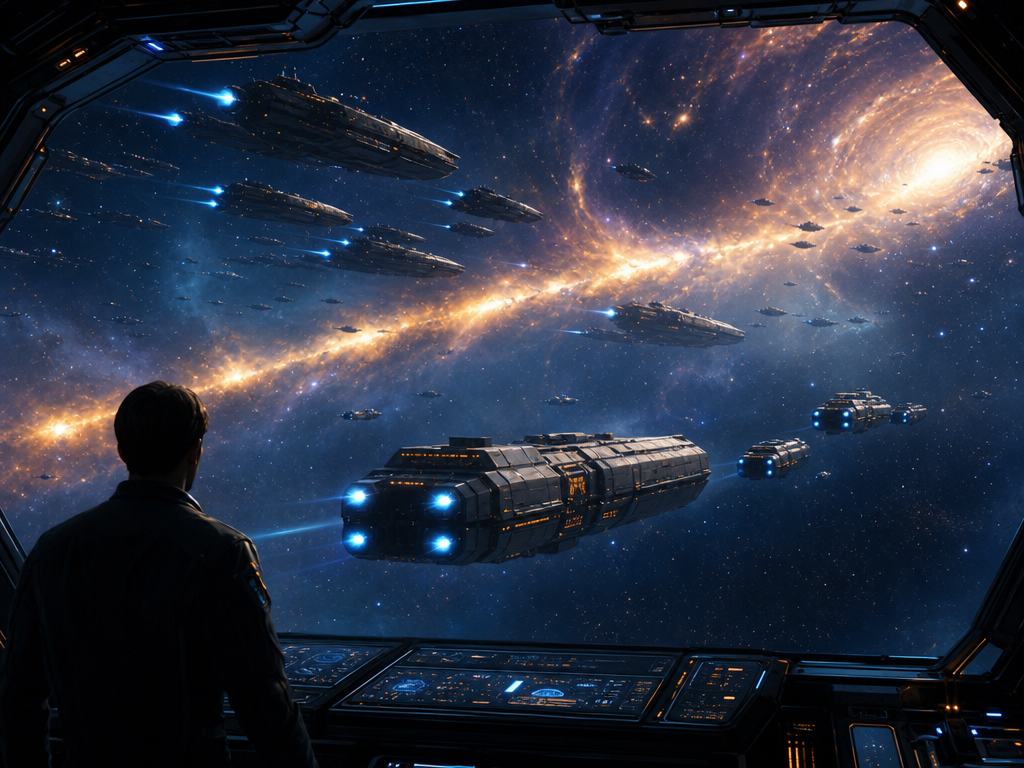
Fifty warships, moving in formation at 0.3c. Dara watched them from Haven’s bridge — a stream of light that crossed the navigation display in seconds, their energy signatures blazing against the dark. Each ship was a kilometer long, their hulls painted in the Dominion’s deep blue, their weapon arrays cold and dark under defensive posture. They were not looking at the convoy. They were looking ahead, toward the Corridor, toward twelve thousand Vael ships, toward the fracture line that was reshaping the galaxy.
Dara counted them as they passed. Fifty ships. Then the main body: four hundred and fifty more, their formation tighter, their engines burning with the steady intensity of ships that had been underway for days and would not stop until they reached the Corridor. The energy output was enormous — enough to light a small star, enough to make the convoy’s seventeen freighters look like candles beside a furnace.
The convoy held formation. Twelve thousand people in seventeen ships, watching five hundred warships pass within two million kilometers. The freighters’ hulls trembled slightly as the battle group’s gravitational wake rolled through — not dangerous, but present. The felt weight of military power moving through space.
Tobin’s transmission completed at Hour 17:11. The data burst — the scout’s profile, the Steadfast’s contact report, Dara’s convoy position — flew toward the advance element on a tight-beam that would reach them in minutes. From there, it would bounce through the relay network to Fort Halo, to Kael’s fleet, to every sensor station in the outer disc. The complete picture of a Vael scout ship mapping Dominion infrastructure, captured by a mining colony’s surplus sensors, now carried by five hundred warships heading into the Corridor.
“Transmission confirmed,” Tobin said. “The advance element received the package. Their communication array is already relaying it.”
Dara nodded. The convoy continued toward Harken’s Landing. The reinforcement fleet continued toward the Corridor. Two trajectories, two purposes, one piece of data connecting them.
She thought about Maren’s note. Your people did more in twenty minutes than our intelligence division managed in seven days. It was true, and it was wrong. Her people hadn’t done anything remarkable. They had measured what was in front of them and transmitted it honestly. That was what miners did. That was what Tobin did. The remarkable thing was that anyone had listened.
“Harken’s Landing, two hours,” Tobin said. “Life support holding. Cargo holds are stable. We’ll make it.”
Dara watched the reinforcement fleet’s engine signatures fade into the distance. Five hundred ships, carrying the Dominion’s response to a crisis that her colony had helped define. The Convergence Corridor burned on the edge of the navigation display, a band of gas and light where two galaxies were beginning to merge.
Her people would reach Harken’s Landing. They would disembark, find quarters, begin the long process of rebuilding lives that had been uprooted in a single night. The colony they had left behind — dark, empty, its relay gate dead — would wait for whatever came next.
But the data they had sent would not wait. It was already in motion, flowing through the relay network, reaching the people who could use it. The scout’s profile. The Vael’s approach vector. The intelligence that a mining colony had captured because someone had the foresight to measure the sky and the stubbornness to transmit what they found.
Dara turned from the viewport and checked the convoy’s status board. All seventeen ships, holding course. Life support stable. Passengers resting. Tobin monitoring.
“Keep us on course,” she said. “I want to be docking at Harken’s Landing before the next relay bounce.”
Tobin nodded and returned to his console. The convoy flew on, twelve thousand people riding overloaded freighters through the dark, while five hundred warships burned toward a confrontation that their data had helped shape.