The Invitation
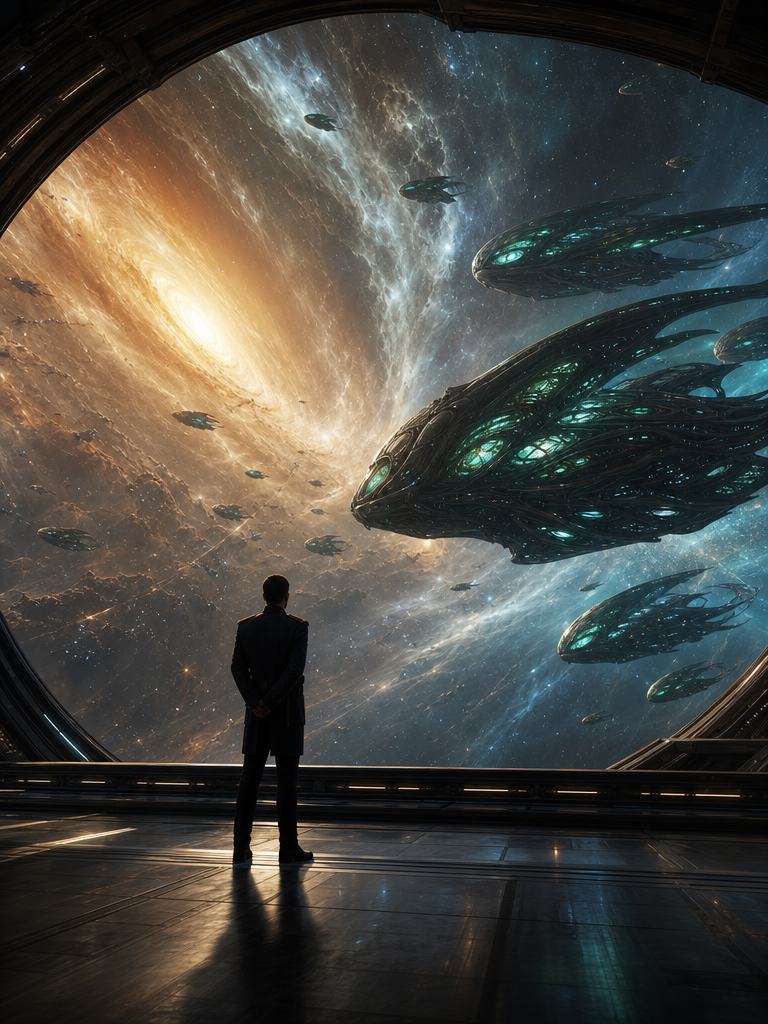
The Invitation
The Upload composition sat on Kael’s personal terminal like a lit fuse.
He had read it three times. The first time on the bridge, surrounded by officers, his face betraying nothing. The second time in his quarters, with the door sealed and the lights dimmed, reading slowly, parsing each phrase. The third time standing at the viewport, the words scrolling in the reflection of his own face while the Convergence Corridor burned behind him.
The Vael described Upload as a transition — not death, not destruction, but a translation. The biological mind, with its trillions of neural connections and its elegant chemical architecture, would be mapped at the quantum level. Every memory, every reflex, every fragment of personality would be preserved in computational substrate. The original biological pattern would cease, but the consciousness it carried would continue — unchanged, uninterrupted, eternal.
Unchanged. That was the word that bothered Kael.
He set the terminal down and pressed his palms against his eyes. The singularity drive hummed through the deck plates, a vibration so constant he had stopped noticing it years ago. Tonight it felt like a second heartbeat — his body’s reminder that it was still here, still biological, still subject to the physics of flesh.
He thought of his daughter. The specific way she said “Dad” when she was about to ask for money — that slightly drawn-out vowel, the pause before the request, as if she were testing whether he was in a good mood. She called him once a month on the relay gate, the signal taking twelve minutes each way, and they talked about nothing important. Her training. His patrols. The weather on Titan Spire. Those conversations were the most real thing in his life. Not because they were profound, but because they were his. His voice. Her laugh. The way she always sounded surprised when he picked up, even though she was the one who called.
If Upload preserved everything — every memory, every reflex, every personality trait — then the daughter on the other side of the transition would still say “Dad” the same way. Would still laugh the same way. Would still be, by every measurable standard, the same person.
But the original would be gone.
Kael dropped his hands and stared at the viewport. Gas and dust drifted in the Corridor’s gravitational pull, slow and indifferent to the civilizations arguing over their nature. He had spent thirty years believing that biological life was precious precisely because it was fragile. Because it ended. Because every conversation with his daughter existed in a window that would close, and that window was what made the conversation matter.
The Vael would say that was a limitation, not a virtue.
He opened a channel to the science station.
“Osei. My quarters. Now.”
Osei arrived in four minutes, his uniform creased from sleep. He stood at attention in the doorway until Kael waved him to the chair across from the desk.
“Sit down, Lieutenant. I need your eyes on something.”
Osei sat. His gaze dropped to the terminal on the desk, where the Upload composition still glowed.
“You’ve read this?” Kael asked.
“Sir?”
“The Vael transmission. The full composition. Have you read it?”
Osei shook his head. “Maren forwarded the linguistic primer. I used it to decode the fleet signatures. But the full composition — no, sir. I didn’t have clearance.”
Kael slid the terminal across the desk. “Read it. Then tell me what you think. Not what the Protocol manual says. What you think.”
Osei picked up the terminal. His eyes moved across the text. Kael watched him read — watched the slight widening of his eyes, the way his fingers tightened on the terminal’s edge, the almost imperceptible shift in his breathing.
It took five minutes. When Osei looked up, his face was unreadable.
“Well?” Kael said.
“The biological mapping is…” Osei paused. “I’ve never seen anything like it. The resolution they’re describing — quantum-level neural mapping — it’s beyond anything in our technology. We can barely map a single neuron. They’re proposing to map every neural connection in a biological brain simultaneously.”
“And the result?”
“The result would be a perfect copy. Every synapse, every chemical gradient, every electrical pattern — reproduced in computational substrate.” Osei set the terminal down. “But it’s a copy, sir. The original is still the original.”
“Is it?”
Osei met his eyes. “The Vael don’t describe it as a copy. They describe it as a transition. The original doesn’t persist — the biological pattern is disassembled during the mapping process. The energy is conserved. The information is preserved. But the biological structure…”
“Dies.”
“I was going to say ‘ceases.’ But yes, sir. The biological structure ceases.”
Kael leaned back in his chair. “So the Vael upload a person and kill the body. And the result is something that thinks it’s the same person.”
“That’s one way to describe it.” Osei’s voice was careful. “I mean — the person who wakes up on the other side would feel continuous. Same memories, same reactions, same… self. It’s the body that’s gone. Not the experience.” He frowned, working through it. “Does that distinction matter? I don’t know.”
“You sound like you’ve thought about this.”
Osei was quiet for a moment. “I’ve been running the numbers since we first detected the biological signatures. If the Vael computational architecture is as integrated as the sensor data suggests — if the substrate cores are genuinely processing information the way biological neurons do — then the Upload isn’t a copy. It’s a migration. The consciousness moves from one substrate to another.”
“But you don’t know that.”
“No, sir. I don’t. I’m reading sensor data from ships that are three light-hours away. I’m making inferences.” Osei paused. “But the Vael have been doing this for thousands of years. If Upload was death, they would have stopped.”
“Or they wouldn’t know they were dead,” Kael said.
Osei considered this. “That’s possible. But the substrate cores are active — I can see that from the energy signatures. Whatever’s running in there, it’s been running for a long time. Thousands of years, if the Archivist’s claims hold.” He rubbed the back of his neck. “The data doesn’t tell me whether it’s the same person. It just tells me something is alive in there and it’s been alive for a very long time.”
Kael stared at the viewport. “The Archivist’s composition says the gift must be freely given. That’s their rule. If Upload was a lie, the entire Resonance would be built on a deception that millions of consciousnesses have verified.”
“Millions of uploaded consciousnesses. Who would have every reason to justify their choice.”
“Yes, sir.”
They sat in silence. The singularity drive hummed. Beyond the viewport, the Convergence Corridor shifted — a slow, vast adjustment of gas and starlight that made the dark feel alive.
“What would you do?” Kael asked.
Osei blinked. “Sir?”
“If the Vael offered you Upload. Right now. Today. Would you take it?”
Osei’s jaw tightened. Kael watched the science officer wrestle with the question — watched the honest answer fight its way to the surface.
“I don’t know, sir,” Osei said. “I want to say no. But I also want to know what it feels like.”
Kael nodded. He had expected honesty. He had gotten it.
“Get back to your station,” he said. “And Osei — don’t mention this conversation to anyone.”
“Understood, sir.”
Osei left. Kael sat in the silence of his quarters and thought about what it meant that his science officer — the man who had first detected the Vael’s biological signatures, the man who understood the data better than anyone in the fleet — could not give a definitive answer.
The doubt was the weapon. Not the fleet. Not the Upload technology. The doubt.
Back on the bridge, the night shift held the watch. Maren was at the communication station, her posture rigid with the particular tension of someone who expected orders at any moment.
“Channel open to the Vael fleet,” Kael said. “On my authority.”
Maren’s fingers moved. “Open, sir.”
Kael stepped into the light of the tactical display. The Vael armada hung on the sensors like a living thing — twelve thousand ships, biological and computational, moving through the Corridor in patterns that defied military doctrine.
“This is Admiral Kael Vasari.” His voice was steady. He made sure of it. “We have received your composition. We have read it. We have questions.”
He paused. The words he had composed in his quarters played in his mind. Not a rejection. Not an acceptance. A challenge.
“You describe Upload as a transition — a preservation of consciousness in new substrate. We cannot verify this claim. We do not have the technology to confirm that what emerges from Upload is the same consciousness that entered it.”
Another pause. The bridge was silent. Maren’s hands were motionless on her console.
“We are not prepared to accept a gift we cannot understand. But we are prepared to listen.” He took a breath. “Tell us what it felt like. The moment of transition. Not the data. Not the theory. What it felt like. And tell us whether you still dream.”
He held the silence for three seconds. Then: “Standing by.”
Maren closed the channel. The transmission raced outward toward the Vael fleet — three hours of void before the words arrived.
Kael leaned against the command chair and watched the transmission icon blink outward on the tactical display — three hours of void before his words arrived.
The hours passed. The fleet held. The contacts maintained their distance — two light-hours, neither closing nor retreating.
Kael did not leave the bridge. He sat in the command chair and watched the Vael formation shift in its organic patterns, thinking about what he had asked. What did it feel like? Do you still dream? They were strange questions for a fleet admiral to ask an alien intelligence. But they were the only questions that mattered.
The answer came three hours and eight minutes later.
Maren’s head snapped up. “Incoming transmission. Vael. It’s…” She frowned. “Sir, it’s not a data burst. It’s a communication. A voice.”
“Source?”
“Nexus-7. Personal channel.”
Kael stood. “Put it through.”
The bridge speakers crackled. Then a voice filled the room — not biological, not quite digital, but something between. The words were Solari, accented with harmonic undertones that the translation system smoothed into meaning.
“Admiral Vasari. I received your question. I will answer it.”
A pause. Kael felt the bridge crew holding their breath.
“The transition was…” The voice hesitated. For the first time, Kael heard something in a Vael communication that was not protocol, not composition, not carefully engineered diplomacy. It was uncertainty. “I was terrified. I had been told it would feel like falling asleep and waking up in a new body. It did not. It felt like dying. For three seconds — three seconds that lasted longer than any biological experience I remember — I was nothing. And then I was everything.”
Another pause. Longer.
“You asked if I still dream. I do. Not images — the Resonance does not process visual data the way biological minds do. But I dream of sensation. The weight of gravity. The taste of salt. The feeling of wind on skin.” The voice dropped. “I dream of things I no longer have. And I do not know if that means the Upload preserved my humanity or if it merely preserved my capacity for loss.”
Kael stood on the bridge. The words filled the space between the crew like a held breath.
“Do you regret it?” he asked.
The response came immediately — faster than the transmission delay should have allowed. Nexus-7 had been waiting for the question.
“No. But I miss what I was. And I think that is the answer you need.”
The channel closed. No one on the bridge moved. The hum of the singularity drive filled the silence — the only sound in a room full of people holding their breath.
Kael looked at the tactical display. Twelve thousand ships hung in the dark, biological and computational, carrying trillions of minds that had once been biological and were now something else. They had crossed four hundred years of void to offer a gift. And the gift was not salvation or destruction — it was a trade. Everything you were for everything you could become.
He thought of his daughter. He thought of her laugh, her stubbornness, the way she said “Dad.” He thought of the three seconds of nothing that Nexus-7 had described — the gap between biological and digital, the moment when consciousness hung suspended between two substrates.
He would not take the Upload. He was certain of that. But he was no longer certain that the Vael were wrong to offer it.
He touched the scar on the back of his left hand — a childhood burn from a training accident on Titan Spire, a thin line of raised tissue that had been with him for forty years. It was useless. It served no purpose. It was a record of a moment that would have been forgotten without it, preserved by the body’s own stubborn insistence on healing.
Kael sat in the command chair and ran his thumb across the scar. Three seconds of nothing. That was the gap. That was the cost.
He closed the terminal and turned back to the tactical display.
“Maintain position,” he said to Maren. “All ships, condition yellow. And open a priority channel to Fort Halo.”
“Fort Halo, sir?” Maren’s fingers paused.
“The Archon needs to hear this. All of it.”