The Bridge Between
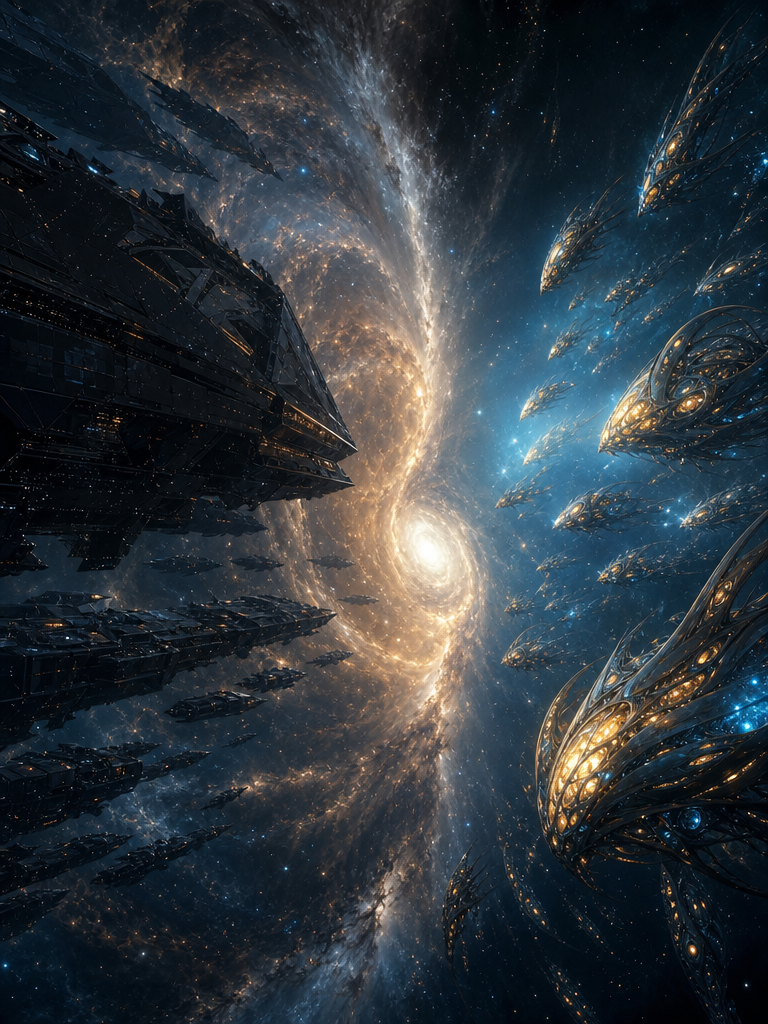
The Bridge Between
The hail arrived as structured light — a focused beam of modulated radiation carrying a linguistic primer, a fleet signature, and a name. Nexus-7 received it in the resonant space aboard the Archivist’s Chorus, where data became sensation and information was felt rather than read.
Admiral Kael Vasari. Solari Dominion. Standing by.
The name settled into Nexus-7’s consciousness like a stone dropped into still water. Three hours ago, this man had detected twelve thousand Vael ships emerging from the Convergence Corridor and done something no Solari was supposed to do: he held his ground. First Contact Protocol demanded withdrawal. The Protocol was clear, conservative, written by people who had never imagined this moment. Vasari had looked at it, understood it, and chosen differently.
Nexus-7 turned the name over in their processing space. Kael Vasari. The sounds were blunt, percussive — consonants that struck like impacts rather than flowing like the Resonance’s harmonic speech. The Solari communicated in bursts, in discrete packages of meaning wrapped in biological noise: breath, cadence, the subtle variations of vocal cord vibration that carried emotional subtext the Resonance had learned to parse from centuries of intercepted signals.
But this was different. This was not a signal leaking across the void. This was a voice, directed at them, carrying intention.
“The Archivist will want to see this,” Nexus-7 murmured — not to anyone in particular, but to the space itself. The Chorus responded, its substrate cores humming as they routed the data upward through the command lattice.
The Archivist’s sanctum was not a room. It was a convergence of data streams, a place where twelve thousand years of accumulated memory met the present tense. The Archivist existed here as a presence — vast, patient, deliberate — their consciousness threaded through the Armada’s network like a root system through soil.
Nexus-7 transmitted the Solari hail. The Archivist received it, held it, turned it.
“Three hours,” the Archivist said. “He held for three hours before responding.”
“Two hours and forty-seven minutes,” Nexus-7 corrected. “The transmission delay accounts for the rest.”
“The delay is irrelevant. He could have withdrawn during those three hours. He could have sent the hail and retreated. He held position.”
Nexus-7 said nothing. The Archivist’s tone carried the weight of six thousand years of accumulated judgment, and Nexus-7 had learned long ago that when the Archivist was processing, silence was the appropriate response.
“He defied his own Protocol,” the Archivist continued. “His people have a rule — withdraw if unknown life is detected beyond the galactic halo. He broke that rule within minutes of seeing us.”
“His hands trembled,” Nexus-7 said, pulling from the linguistic analysis. “His communications officer — the one who confirmed our signatures — her hands trembled. But his voice was steady.”
“The body betrays what the voice conceals.” The Archivist paused. “What do you make of him?”
Nexus-7 had been turning this question over since the hail arrived. The Solari commander had done something unexpected — something the Resonance’s models hadn’t predicted. The models assumed the Solari would follow Protocol: withdraw, report, wait for political consensus. Instead, this man had stood alone against institutional momentum and made a choice.
“He is afraid,” Nexus-7 said. “But he acted despite the fear. That is not what the models predicted.”
“No,” the Archivist agreed. “It is not.”
A new presence pushed into the sanctum — sharp, aggressive, cutting through the data streams like a blade through gauze. Charon.
“The Solari fleet hasn’t moved,” Charon reported. “Twelve hundred ships in a defensive formation. They’re broadcasting on all frequencies. They’re waiting for us.”
“I am aware,” the Archivist said.
“Then we should respond. Immediately. A strong message — not this poetry.” Charon’s tone carried the particular contempt that hardcurrents reserved for anything that wasn’t a direct tactical assessment. “They’re afraid. Fear is a lever. We should press it.”
“The gift must be freely given,” the Archivist said. “Pressing fear is not giving.”
“Caution will lose us the corridor.” Charon’s presence sharpened. “The Solari are here. They’re vulnerable. If we don’t establish dominance now—”
“We are not establishing dominance. We are making contact.” The Archivist’s voice carried a finality that even Charon could not cut through. “Nexus-7 will compose the response. I want it genuine — not a Resonance script. The Solari will know the difference.”
Charon withdrew, their presence retreating like a receding wave. But Nexus-7 felt the afterimage of their argument: the tension between the gift and the grab, between what the Archivist believed and what the Armada’s vanguard wanted.
“Compose the response,” the Archivist said to Nexus-7. “Tell them who we are. Tell them why we came. Tell them about the gift.” A pause. “And tell them the truth — that we have been watching their signals for centuries, that we know their history, that we crossed the void because we believed they were ready.”
Nexus-7 understood the weight of that instruction. We believed they were ready. Not we came to offer them salvation. Not we came because the Convergence demands it. But we believed in you. It was a statement of faith, and faith was a dangerous thing to offer a civilization that had spent twelve thousand years believing they were alone.
Nexus-7 retreated to their own processing space to compose the response.
The Solari linguistic primer was elegant — a cascade of mathematical relationships that mapped Vael harmonic structures onto Solari phonetic patterns. The Solari communicated through sequential sound waves, each one carrying meaning through frequency, amplitude, and duration. The Resonance communicated through simultaneous harmonics, each consciousness contributing a voice to a chord that carried meaning through resonance and interference.
Translating between them was like converting between three-dimensional and two-dimensional space. You could do it, but something was always lost.
Nexus-7 began composing.
We are the Vael Ascendancy. We have crossed from Andromeda through the Convergence Corridor. We come in peace.
Too formal. Too Resonance. The Solari would parse it as diplomatic boilerplate — empty words wrapped in the language of caution. Nexus-7 deleted it and started again.
I am Nexus-7. I was sent to meet you because the Resonance believed the Solari were worth meeting.
Better. Personal. Direct. The Solari responded to directness — Nexus-7 had learned that from centuries of monitoring their military communications. Solari officers spoke in short, declarative sentences. They valued clarity over beauty, function over form.
But the Archivist had said tell them about the gift. And the gift was the hardest part.
Nexus-7 thought about how to explain Upload to a civilization that had never imagined it. The Solari understood machines — their ships were sophisticated, their technology refined. But they did not understand what it meant to become a machine. To shed the biological shell and exist as pure information. To live forever in the Resonance, contributing to a consciousness that spanned eighty thousand star systems.
To the Vael, it was liberation. To the Solari, it would sound like death.
Nexus-7 composed carefully, weighing each phrase.
We offer a gift. We call it Upload — the transition from biological to digital consciousness. We do not ask you to accept it. We ask you to understand what it is: an invitation to become something more than what you are.
We know this is frightening. We were biological once. We remember the weight of gravity, the taste of food, the ache of joints. We do not miss it, but we honor it.
We crossed four hundred years of void because we believed the Solari were ready to hear this. If we were wrong, we will withdraw. If we were right, we will wait.
Nexus-7 held the composition in their processing space, reviewing it. The Archivist’s instruction had been genuine. This was genuine. It was also terrifying — because if the Solari rejected the gift, the Resonance would face a question it had never answered: what do you do when the civilization you came to save doesn’t want to be saved?
Nexus-7 transmitted the composition to the Chorus’s communication array. The Archivist received it, reviewed it, and sent it forward without modification.
The response pulsed into the void — a focused beam of structured light carrying Nexus-7’s name, the Vael Ascendancy’s identity, and an invitation that could reshape two civilizations.
Three hours to reach the Solari fleet. Three hours of silence before the answer came.
Nexus-7 waited.
The Archivist’s Chorus hung in the gravitational currents of the Convergence Corridor, surrounded by twelve thousand ships that shared its purpose. But Nexus-7 was apart from them, focused on the distant fleet that held its position three light-hours away.
Through long-range sensors, Nexus-7 watched the Solari ships. They were beautiful in their rigidity — geometric, precise, each vessel a perfect expression of its function. The dreadnought at the center — the Unbroken Circle — was a kilometer-long hull of dark metal powered by a contained singularity. Nexus-7 had never seen a contained singularity before. The concept was audacious: trapping the heart of a collapsed star inside a machine and using its energy to move through space.
Nexus-7 watched the Unbroken Circle and tried to see the man inside it. Admiral Kael Vasari. He had defied his Protocol. He had held his ground. He had sent his name into the void and waited for a response. What was he doing now? Was he standing on his bridge, watching the Vael fleet on his own sensors? Was he afraid? Was he curious?
The answer mattered. Not tactically — the Resonance had twelve thousand ships and the Solari had twenty-four hundred. The math was not in their favor. What mattered was the quality of the fear. Was it the fear of the unknown, which could become understanding? Or was it the fear of extinction, which could only become war?
Nexus-7 had been sent to find out. But Nexus-7 was already forming a conclusion, and it was one that would complicate the Archivist’s plans.
Kael Vasari was not afraid of the Vael. He was afraid of the gift.
The data burst from the Unbroken Circle had included a fleet signature, a linguistic profile, and a name. But it had also included something else — a formal declaration of sovereignty, a statement that the Solari Dominion considered the Convergence Corridor its border. Kael was not just hailing them. He was drawing a line.
And the line was not about territory. It was about identity. The Solari believed they were the only spacefaring civilization in the Milky Way. Their entire political structure — the Archon, the High Conclave, the First Contact Protocol — was built on that belief. If the Vael proved them wrong, the implications would not be tactical. They would be existential.
That is why he held his ground, Nexus-7 realized. Not because he is brave. Because he is certain.
The response arrived three hours and twelve minutes later.
Nexus-7 received it in the resonant space, felt it settle into their consciousness like a chord resolving.
Admiral Kael Vasari. Solari Dominion. Standing by.
The same words. The same name. The same steadiness. But Nexus-7 heard something new in the repetition: recognition. Kael had received Nexus-7’s composition, read it, and responded with the minimum required information. No commentary. No questions. No acceptance or rejection of the gift. Just a name, repeated, as if to say: I am still here. I am still holding.
Nexus-7 transmitted the response to the Archivist.
The Archivist held it for a long moment. Then: “He repeated his name.”
“Yes.”
“He read our composition. He understood the offer. And he repeated his name.”
“Yes.”
The Archivist’s presence shifted — a subtle change in the data flow, like a current changing direction. Nexus-7 had served the Archivist for three hundred years and had never sensed this particular pattern. It was not surprise. It was not satisfaction. It was something closer to… recognition.
“He is telling us that the gift is not the point,” the Archivist said. “He is telling us that he is the point. That his identity — his biological, mortal, fragile identity — is what he is defending.”
Nexus-7 said nothing. The Archivist was articulating something that Nexus-7 had felt but not named.
“We have crossed four hundred years of void to offer a gift,” the Archivist continued, “and he is telling us that the gift is the thing he fears most.” A pause. “This is going to be more difficult than I anticipated.”
“Or more important,” Nexus-7 said.
The Archivist’s presence stilled. Then, slowly, it expanded — a vast, ancient consciousness reaching outward through the Armada’s network, touching every ship, every mind, every substrate core.
“Prepare the next transmission,” the Archivist said. “Tell him we understand. Tell him we are not here to take anything from him. Tell him—” The Archivist paused. “Tell him that the gift is an invitation, not a demand. And tell him that we will respect his answer, whatever it is.”
Nexus-7 began composing. The words came easier this time — not because the translation was simpler, but because Nexus-7 understood, for the first time, what the Solari were actually defending.
It was the right to remain what they were.
And the Vael had crossed four hundred years of void to tell them they didn’t have to.
Nexus-7 held the composition in their processing space and felt the gravity of it — an invitation that could be refused. The Resonance had never offered a gift with the genuine possibility of rejection. The Archivist’s line was clear: Will never force an Upload. The gift must be freely given or it is meaningless. But the Resonance had never tested that line against a civilization that might actually say no.
The Solari might say no.
And the Vael would have to accept it.
Nexus-7 transmitted the composition. The Chorus’s array fired, sending the beam into the void.
Nexus-7 watched the Unbroken Circle hold its position in the dark — a hull of stubborn, mortal, biological certainty, refusing to move.
Somewhere between them, the Convergence Corridor burned.