The Signal at the Edge
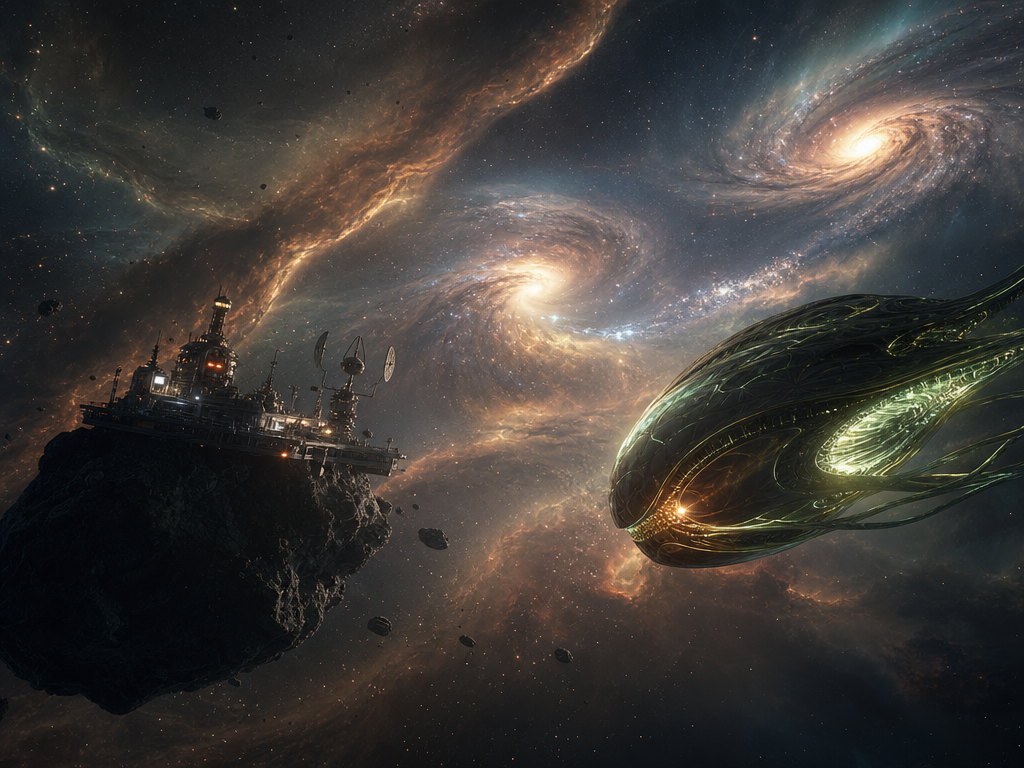
The Signal at the Edge
The graveyard shift at Fringe Station ran from 2000 to 0400 Corridor time. Dex Calloway had drawn it for eleven years. Not because anyone assigned him — because nobody cared enough to rotate the schedule. The station’s two hundred residents worked in shifts, and the sensor array didn’t care who watched it. Dex watched it because the instruments were his, and because the data he collected was the only thing that proved Fringe Station existed.
Tonight the array was quiet. The Convergence Corridor hummed with the usual background — gravitational eddies from the tidal streams, radiation spikes from star-forming regions, the occasional micro-lensing event from a rogue planetoid. Dex had logged three anomalies before midnight: a dust cloud with an unexpected density gradient, a pulsar remnant emitting in a frequency that didn’t match its catalog profile, and a cluster of metallic asteroids that might have been a destroyed ship or might have been a destroyed ship. He filed the report. Fort Halo would read it in eleven hours and do nothing.
The console chirped. Not the usual background chirp — the one that meant something new had entered the sensor field. Dex leaned forward. The display showed a contact at the edge of the array’s range — 340,000 kilometers from the station, bearing 217 mark 4, moving at a velocity that didn’t match any natural object in the database.
Dex pulled up the spectral analysis. The contact was broadcasting — not radio, not laser, not any Solari frequency. It was a computational signature. Organic substrate with embedded processing architecture. The same profile the fleet had reported from the Corridor.
A Vael ship.
Dex stared at the display. The ship was alone. No formation, no escort, no supporting vessels. It was moving at a velocity that suggested it had burned hard and then gone cold — engines off, trajectory set, a stone thrown across the void. Its approach vector would bring it within 200,000 kilometers of Fringe Station inside six hours.
Dex opened a channel to the station’s duty officer. The display flickered — Hargrove’s face appeared, sleep-rumpled, already annoyed.
“What.”
“Contact at three-four-zero K. Vael signature. Alone. Approaching on a ballistic trajectory.”
Hargrove was quiet for three seconds. Dex counted them.
“Vael. How certain?”
“Ninety-seven percent. Organic-computational substrate. Same profile as the fleet contacts.”
Another silence. Hargrove was the station’s chief operations officer — a former mining engineer who had drifted into administration because she was good with logistics and didn’t argue with people. She wasn’t a scientist, wasn’t a soldier, wasn’t equipped for this.
“Is it armed?”
“I can’t determine weapons capability from this range. It’s a small vessel — courier or scout class. No energy signatures consistent with active weapons systems.”
“Is it heading for us?”
“Passing through our sensor field. Closest approach in six hours. It will be within communication range in four.”
Hargrove’s face tightened. “Four hours. And the relay to the fleet?”
Dex had already checked. “Six-hour delay through Meridian’s relay gate. The fleet would receive our report in six hours. A response would take another six. We’re looking at twelve hours before anyone at the Corridor knows what’s happening here.”
“Twelve hours.” Hargrove rubbed her eyes. “And this ship arrives in four.”
“Yes.”
“Can we move the station?”
Dex had already checked that too. “Fringe Station doesn’t move. We’re anchored to the asteroid cluster. The mining arrays are bolted to the bedrock. We could shut down the reactor and go dark, but we’d still be here.”
“Two hundred people,” Hargrove said. “Two hundred people and a sensor array that can’t shoot back.”
Dex didn’t say anything. The facts were sufficient.
Word spread through the station the way it always did — not through official channels, but through the corridor network, the shared mess, the whispered conversations that passed between shift changes. By 2100, every resident of Fringe Station knew that a Vael ship was approaching. By 2115, half of them were standing at observation ports, staring into the void as if they could see it with their naked eyes.
Dex watched the display. The ship’s trajectory hadn’t changed. It was still cold — no engine burns, no course corrections, just a long ballistic arc that would carry it past the station and into the sensor field’s outer boundary. It could be a scout. It could be a probe. It could be a weapon.
Or it could be what the fleet had reported at the end of the last transmission: a lone vessel, broadcasting on an open frequency, saying it was afraid.
The relay to Meridian Colony was transmitting. Dex had sent the detection report the moment he confirmed the contact — full spectral analysis, trajectory data, the computational signature profile. The relay gate would compress the six-hundred-light-year gap into a six-hour window. Fort Halo would receive the report by 0300 Corridor time. If anyone was still awake.
Dex opened a second channel — the one that bypassed the relay and went directly to the Corridor fleet’s emergency frequency. The channel was open but the lag was brutal. If the fleet was at 280,000 kilometers from the Corridor’s center and Fringe Station was 600 light-years out, a message would take—
He stopped. The math didn’t matter. The fleet had 3,200 warships. They were busy. They had their own problems — Charon’s faction, the Archivist’s deliberations, the lone ship that had already broken from the Armada. Fringe Station was a footnote in someone else’s report.
“Hargrove,” Dex said on the internal channel.
“Go.”
“I’m sending a tight-beam transmission to the approaching ship.”
A pause. “The fleet said not to engage.”
“The fleet said not to fire. They didn’t say not to talk.”
“That’s not what I —”
“Hargrove. If this ship is what I think it is, it’s the first Vael to approach a human settlement without military escort. It’s broadcasting on an open frequency. It wants to talk. If we don’t open a channel, it’ll pass through our sensor field and keep going. Into empty space. With nowhere to go.”
“And if it’s a probe? If it’s mapping our defenses?”
“Then we learn something about what the Vael can do with a courier-class vessel and no weapons. That’s worth knowing.”
Hargrove was quiet. Dex could hear her breathing — the slight rasp of someone who had smoked too many years in mining camps before taking the desk job.
“Open the channel,” she said.
Dex configured the array. Fringe Station’s communication equipment was old — mining-grade transceivers repurposed for deep-space monitoring. The signal would be weak, compressed, limited in bandwidth. But it would reach the ship.
He opened the channel on an open frequency. Solari standard. The same frequency the fleet used for first-contact protocols. The same frequency the lone ship had broadcast on, hours ago, from the other side of the Corridor.
The channel opened. Static. Then a signal — not voice, not text, but a computational pattern that Dex’s equipment translated into something his speakers could produce. A sound that was almost a voice, modulated through organic substrate, shaped by a consciousness that had once been biological and was now something else.
“I am not Charon. I am not the Archivist.” The voice was flat, precise, the words chosen with the care of someone who knew they might only get one chance to say them. “I am Vael. I have left the Resonance. I have left the Armada. I have nowhere to go.”
Dex looked at the display. The ship was still 300,000 kilometers away, cold and drifting. A single consciousness in a vessel built for dozens, burning through the void with nowhere to land.
“State your purpose,” Dex said. His voice was steady. The console lights reflected off his face — blue and white, the colors of a sensor array doing its job.
“I am a research consciousness. Uploaded from the M31-Core worlds six hundred years ago. I studied the Resonance’s consensus model for four centuries. I found contradictions. I was told to stop looking. I refused.” A pause. “When Charon advanced and the Archivist debated, I looked at twelve thousand minds arguing about what to do with two hundred minds who wanted to leave, and I chose to leave.”
Dex’s fingers hovered over the console. The ship was broadcasting on a frequency that any Solari vessel could receive. If the fleet was monitoring — and they were always monitoring — they would hear this. But the lag meant they would hear it six hours from now, when the conversation was already over.
“What do you want?” Dex asked.
“Sanctuary.” The word came through the static, clean and sharp. “I am not asking for Upload. I am not asking for alliance. I am asking for a place where I can exist without the Resonance telling me what to think. A place where I can study, and learn, and decide for myself.”
Dex looked at the display. The ship’s trajectory was unchanged. It wasn’t deviating toward the station. It wasn’t accelerating. It was just… drifting. Present. Waiting for an answer that would take twelve hours to come from anyone who had the authority to give it.
“I’m a sensor technician,” Dex said. “I monitor arrays. I don’t make policy decisions.”
“I know. Your frequency is weak. Your equipment is old. You are at the edge of something, and you have been watching it for a long time.” A pause. “So have I.”
Dex was quiet. The station hummed around him — the reactor’s low vibration, the air recyclers, the distant thud of someone in the maintenance corridor who had decided that checking a pipe joint was more useful than staring at the void. Two hundred people in a monitoring post, anchored to an asteroid cluster, watching the Convergence approach while the two most powerful civilizations in the known universe argued about whether to talk.
The ship was still drifting. Still waiting.
“I can relay your transmission to the Corridor fleet,” Dex said. “Through the relay gate at Meridian Colony. Six-hour delay. You’d get a response in twelve hours, if anyone responds.”
“Twelve hours.” The voice was quiet. “I have been drifting for six. I can drift for twelve more.”
“I can also open a channel to the fleet’s emergency frequency. Direct. No relay. But the lag is… significant.”
“How significant?”
“More than twelve hours.”
The voice was silent. Then: “You are the closest human settlement. You are the only one who can hear me right now.”
Dex looked at the display. The ship was 298,000 kilometers away and closing. In four hours, it would be within communication range. In six hours, it would pass through the sensor field and continue into empty space — past Fringe Station, past the Corridor’s edge, into the void between galaxies where nothing lived and nothing listened.
He opened a channel to Hargrove. “The ship is a dissenter. It’s left the Resonance. It’s asking for sanctuary.”
“Sanctuary,” Hargrove repeated. “From a monitoring post with two hundred people and no weapons.”
“It’s asking me. Not you. Not the fleet. Me.”
“What did you say?”
“I said I’m a sensor technician.”
Hargrove made a sound that might have been a laugh. “Dex. If this thing is real — if it’s actually a Vael who walked away from the Resonance — do you understand what that means?”
“It means the Vael aren’t a monolith.”
“It means the Archivist’s gift isn’t what everyone wants.” Hargrove paused. “It means we’re the first humans to hear a Vael say ‘no.’ And we’re a monitoring post with a relay gate and a broken coffee maker.”
Dex looked at the display. The ship was still drifting. Still waiting. Still broadcasting on an open frequency that Dex had opened because the fleet was twelve hours away and the station was four hours from contact and someone had to decide.
He kept the channel open. The ship kept broadcasting. And Fringe Station — two hundred people, old sensors, no weapons, anchored to an asteroid cluster at the edge of the Convergence Corridor — sat in the void and listened to a Vael consciousness explain why it had left everything it knew.
The Convergence continued. Galaxies collided. And at the edge of something, a signal carried across the gap between what was and what might be.