The Scout
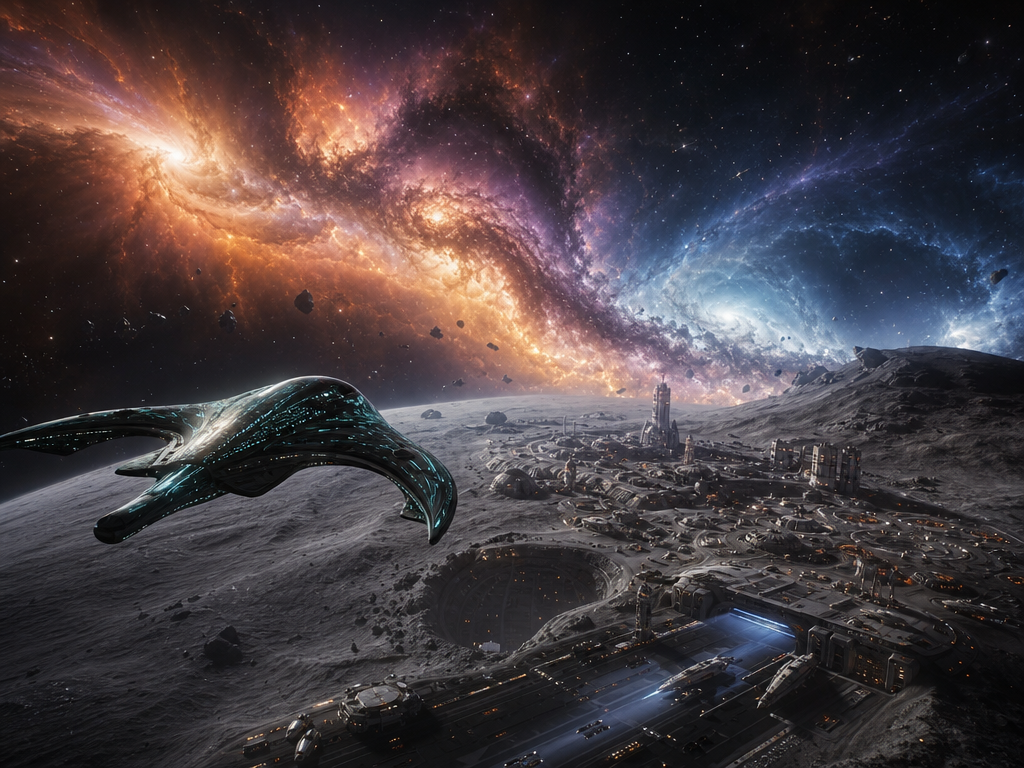
The Scout
The freighters were full. All fourteen of them, packed tight with families and supply crates and the kind of silence that settled over people who had stopped asking questions. Three passenger transports held the children, the elderly, the medical patients. The cargo holds of the freighters held everyone else — nine thousand two hundred people loaded in eighteen hours, sleeping on improvised cots between pallets of mining equipment.
Three thousand eight hundred remained on the moon.
Dara stood in the harbor control room, staring at the loading manifests. The numbers had not changed in six hours. There were no more ships. The harbor’s docking clamps held fourteen freighters and three transports, and every one of them was full. The remaining population was waiting in the residential sectors, sleeping in shifts, eating from ration stores. They knew something was happening — the midnight evacuation had been impossible to hide — but they did not know what, and Dara had not told them.
Tobin’s voice came through the comm. “Warden. Sensor bay. Now.”
She was there in forty seconds. The sensor bay was Tobin’s domain — a converted mining office with walls of data screens and the relay gate’s power feeds running along the ceiling like veins. Tobin stood at the main console, his tablet forgotten on the desk beside him. His face was the one Dara had learned to read over fifteen years: not alarmed, not urgent, but precise. The face of a man who had measured a problem and found it exactly as large as he feared.
“Look at this.”
He pulled up the sensor feed. The Convergence Corridor filled the main screen — a band of gas and light that had been brightening for three years. The electromagnetic signatures were there, as always: the Vael fleet’s energy output, bleeding through the Corridor’s gravitational turbulence like heat through a wall. Dara had seen these signatures every day for months. She knew their frequency profile, their drift pattern, their slow intensification.
But this was different.
“Thirty-seven minutes ago,” Tobin said, “a new signature appeared. Separate from the main fleet. Single source. Moving on an independent vector.”
He zoomed in. The signature was small — a fraction of the Armada’s collective output — but distinct. It was not a natural phenomenon. It was not a gravitational echo. It was a ship. One ship, breaking from the fleet’s formation and heading directly toward Meridian.
“Distance?” Dara asked.
“Twelve light-hours. Closing at 0.3c. It’ll reach sensor range in —” Tobin checked his tablet. “Six hours. Maybe five, if it accelerates.”
Dara looked at the screen. A single point of light, moving through the Corridor’s gas clouds, heading for Meridian Colony. A Vael scout ship. The first alien vessel any human settlement would see up close.
“Is it weapons-capable?”
“Unknown. The energy signature is consistent with a small military craft — fast, probably lightly armed. But I can’t confirm weapons from this distance. The interference is too strong.”
“How long have you known?”
“Since thirty-seven minutes ago.” Tobin’s voice was flat. He had already processed the data, already calculated the trajectory, already built the implications. “I confirmed it three times before calling you. It’s real, Warden. It’s not a sensor ghost.”
Dara stood very still. The Convergence Corridor burned on the screen, and at its center, a single point of light was crossing the void toward twelve thousand people who had no warships, no weapons, no defense beyond a relay gate and a harbor full of overloaded freighters.
“Fort Halo doesn’t know about this,” she said.
“Fort Halo doesn’t know about any of this. The relay gate is still functional — I can transmit the sensor data now. But it’ll take six hours to reach them. And by then the scout will be here.”
Six hours. The same delay that had plagued every communication since Meridian was built. Six hours for light to cross the gap between the colony and the nearest Dominion authority. Six hours in which Dara would have to decide everything alone.
She pulled up the evacuation status. Fourteen freighters, three transports, fully loaded. Nine thousand two hundred passengers. Three thousand eight hundred people still on the moon. The cargo holds were rated for equipment, not human beings — no life support, no pressurization, no climate control. Loading them had been an improvisation. Evacuating in them would be worse.
“Can we launch now?” she asked.
“The freighters are ready. The transports are ready. But we can’t fit the remaining population into the cargo holds without cutting ventilation to the lower decks. The freighters weren’t built for this many people.”
“I know what they were built for. Can we do it?”
Tobin was quiet for three seconds. Three seconds in which Dara could hear the hum of the relay gate’s power feeds and the distant thrum of the harbor’s loading cranes.
“We can do it,” he said. “But if the gate fails during launch — if we lose the relay — Meridian is alone. No communication with Fort Halo. No way to call for help.”
“The gate is running at full power?”
“Full power. Diagnostic systems are offline. I’m running everything through the core function.” He paused. “I can maintain the gate and launch the ships simultaneously. But I’ll need to divert power from the harbor’s docking controls to the gate’s relay array for the transmission. The launch sequence will run on manual.”
“Manual launch?”
“The docking claps will release on physical command. Each ship will need a crew in the harbor to trigger the release individually. No automation.”
Dara thought about it. Manual launch meant more time. More time meant more risk — the scout was closing, and every minute Meridian stayed put was a minute the colony was visible to an alien ship whose intentions were unknown.
But the data mattered. The scout ship’s sensor profile — its energy output, its approach vector, its speed — would be critical intelligence for Kael’s fleet. If Meridian transmitted that data before leaving, the Corridor would know exactly what was coming.
“If we transmit first, the data reaches Fort Halo in six hours,” Dara said. “If we leave first, we can’t transmit at all.”
“Correct.”
“And the scout will be in range in five hours.”
“Five hours, potentially less.”
Dara made the decision in the time it took to breathe. She had been making decisions like this for three years — weighing incomplete information against incomplete options, choosing between bad and worse. The Convergence had taught her to stop waiting for perfect data. Perfect data was a luxury for people who lived six hours away from the edge.
“We transmit first,” she said. “Full sensor package. The scout’s bearing, speed, energy profile, approach vector. Everything we have. Then we launch.”
“That’s cutting it close. The transmission will take thirty minutes to compile. Launching all seventeen ships on manual will take another forty. That’s seventy minutes. We’ll have four hours and ten minutes of margin before the scout arrives.”
“Then we work fast. Get the harbor crews to the docking controls. I want every ship prepped for manual release.”
Tobin nodded and was already moving.
Dara sent the order through the colony’s internal comm — not a general announcement, but direct channels to each department head. Harbor crews to docking controls. Medical teams to transport holds. Life support technicians to the cargo holds to improvise ventilation for the civilian passengers.
The colony moved. Not with panic — panic had been drained out of Meridian’s population over three years of watching the sky burn — but with the particular urgency of people who understood that hesitation was a cost they could not pay.
Dara stood in the harbor control room and watched the manifests update. The cargo holds were filling. Families who had been sleeping in the residential sectors were being guided through the corridors by section chiefs, carrying children and ration packs and the small personal items that people grabbed when they had sixty seconds to decide what mattered.
She opened a channel to Tobin.
“Transmission status?”
“Compiling. Twenty-two minutes to complete. The relay gate is holding — full power, stable carrier wave. The data package will include the scout’s full sensor profile, our gravitational readings for the past forty-eight hours, and the electromagnetic drift analysis.”
“Send it to Fort Halo. Address it to the Archon’s office, priority one. Copy to Kael’s fleet relay.”
“Kael’s relay?”
“If the fleet is still holding the Corridor, they need this data. The scout’s approach vector will tell them where the Vael are sending reconnaissance. That’s tactical intelligence.”
Tobin paused. “You’re sending military intelligence to a fleet admiral.”
“I’m sending what I have to whoever can use it. Fort Halo will sit on it for six hours. Kael might act on it in minutes.”
“Understood.”
Dara closed the channel. The harbor cranes hummed — a sound she had heard every day for three years, the mechanical pulse of a colony that existed to pull minerals from the debris of two dying galaxies. In thirty minutes, those cranes would fall silent, and Meridian Colony would become a memory.
She thought about the people on this moon. The miners who had spent decades extracting rare elements from tidal deposits. The engineers who had built the relay gate and the life support systems and the habitation modules. The children who had been born here and knew no sky but the Convergence’s burn. Twelve thousand people who had come to the edge of everything because someone had told them the minerals were valuable and the view was worth the risk.
The view had been worth the risk. For two hundred years, Meridian Colony had thrived on the edge of two galaxies, mining the debris of their collision, watching the sky change color as the Convergence accelerated. The colonists had built a life here — not a temporary outpost, but a home, with schools and hospitals and the particular comfort of a community that had weathered three years of brightening skies and six-hour relay delays.
And now a single alien ship was crossing the void toward them, and the home they had built was about to become a waypoint in a war they had no part in.
The transmission completed at 0347.
“Sending now,” Tobin said. “Full data package. Fort Halo priority one. Fleet relay copy.”
“Launch sequence,” Dara said. “All ships. Manual release. Go.”
The harbor came alive. On the docking level, crews moved to each freighter’s release controls — physical switches, no automation, each one requiring a crew member to stand at the panel and trigger the clamps by hand. Dara watched the status board as each ship went from docked to releasing.
First freighter: Meridian’s Fortune. Released. Engines spooling.
Second: Long Haul. Released.
Third: Children of the Drift. Released.
The names scrolled up the board — the names the colonists had given their ships, names that reflected two hundred years of mining history and frontier life. Dara read them and felt something settle in her chest. Not grief. Something harder. The recognition that these ships were carrying twelve thousand people into the void, and the void did not care about names.
“Fourteen freighters released,” the harbor master reported. “Three transports releasing now.”
“Life support status on the cargo holds?”
“Functioning. Tobin’s team improvised ventilation feeds from the maintenance ducts. Temperature is stable. Air quality is — adequate.”
“Adequate is enough. Get them out.”
The transports released. Seventeen ships, engines spooling, climbing away from Meridian’s surface on columns of blue-white thrust. Dara watched them from the harbor control room’s viewport — a string of lights rising against the Convergence Corridor’s burn, each one carrying hundreds of people who had woken up on a moon and would go to sleep on a ship.
She was the last person in the harbor. The docking clamps were empty. The loading cranes stood silent. The relay gate hummed behind her, its power feeds still warm, still carrying data to Fort Halo and the Corridor.
Tobin’s voice came through the comm. “All ships are clear. Holding orbit at two hundred kilometers. Awaiting your command.”
“Bring them to departure formation. Route them to Harken’s Landing — nearest friendly port. Eighteen hours at standard burn.”
“Understood.” A pause. “Warden. The relay gate. I’m going to have to shut it down once we’re clear. Power reserves won’t sustain a full transmission without the colony’s reactor.”
“I know. Send one more thing before you kill it.”
“What?”
“The scout’s bearing and speed. Updated readings. Send it to Kael’s fleet relay with a note: Meridian Colony, Warden Dara, day six. This is what we saw. Use it well.”
Another pause. Then: “Sending.”
Dara stood in the empty harbor and watched the relay gate’s power feeds dim. The hum faded. The data — the scout’s profile, the gravitational readings, the electromagnetic drift — was already in flight, racing through the Corridor’s gravitational turbulence toward a fleet that was holding position against twelve thousand ships.
She had done what she could. The data was in the hands of people who could use it. The colony was in the void, running for the nearest port. And Dara was alone in the harbor, the last person on Meridian, the warden who had promised to be last to leave.
She walked to the docking level. The airlock was still pressurized — the gate’s last reserves. She sealed her suit, cycled the lock, and stepped into the corridor that led to the surface pad. The pad was empty. The ships were gone. The Convergence Corridor burned overhead, painting the moon’s surface in amber and violet.
Dara called the harbor master’s frequency. “I’m clear. Shut the gate.”
The relay gate died. The hum stopped. Meridian Colony went dark — no power, no communication, no connection to the Dominion or the fleet or the twelve thousand people who had just left it behind.
Dara boarded the last shuttle. She sealed the hatch, fired the engines, and lifted off the surface of a moon that had been her home for fifteen years. Below her, the colony’s lights winked out one by one as the reactor powered down.
She climbed until the Convergence Corridor filled the viewport. Gas clouds and displaced stars, burning in the void. The freighters and transports were ahead of her, a chain of lights heading for Harken’s Landing. The scout ship was behind her, closing, still hours away.
Dara set her course and joined the formation. Twelve thousand people, seventeen ships, one warden. Running from a moon that had been home, toward a port that was not, carrying data that might change everything.
The Convergence burned. The ships flew. And Meridian Colony, dark and empty, waited for whatever came next.