The Conclave's Edge
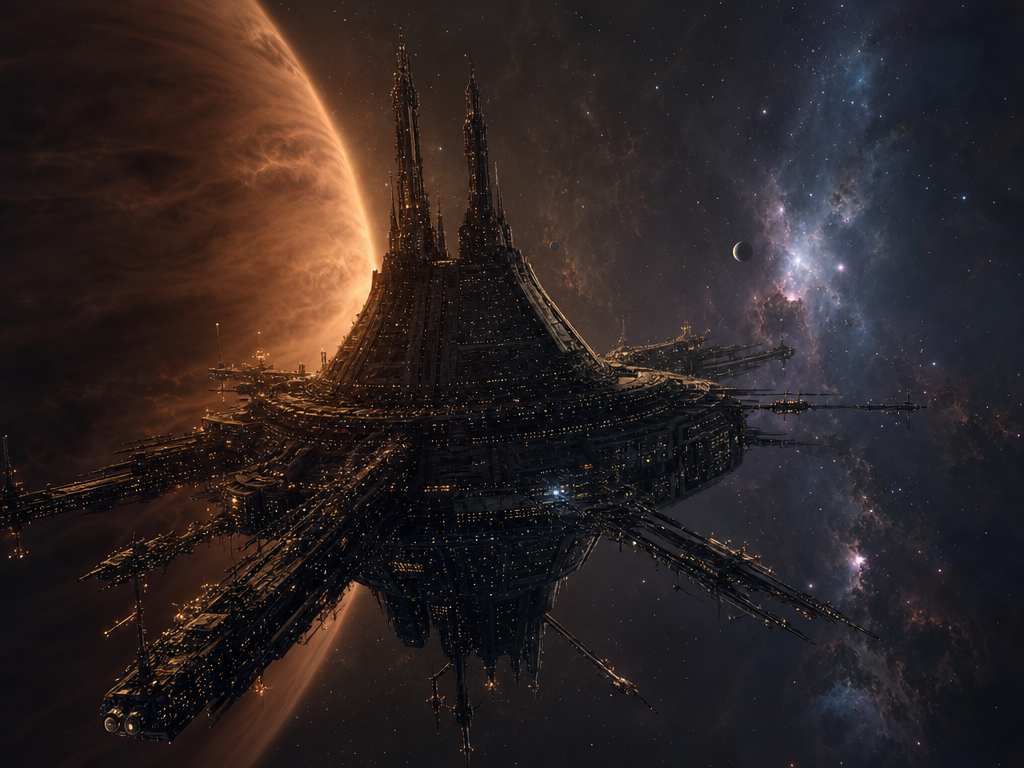
The Conclave’s Edge
The report arrived at 0612, eleven hours after Kael had sent it. Archon Seren Vaal read it twice in the silence of her office, the brown dwarf’s dim light filtering through the viewport like an ember that had forgotten how to burn.
The words were precise. Kael’s reports always were. The Vael Armada — twelve thousand ships, biological signatures, energy readings that matched nothing in the Dominion’s threat library. First Contact Protocol demanded withdrawal. Kael had held position.
Seren set the datapad down. The office was small by design — she had inherited it from three predecessors who understood that power exercised from a cavernous room felt like theater, while power exercised from a space barely large enough for two people felt like a threat. The desk was reinforced steel. The walls were bare. The only decoration was a framed copy of the Protocol itself, the original text from twelve thousand years ago, when the Dominion’s founders first declared that they would not repeat the mistakes of Old Earth.
The Dominion expands only into uninhabited systems. If sapient life is detected, the fleet withdraws immediately. There are no exceptions.
Kael had made an exception.
Seren pressed the comm panel. “Director Voss. Conclave chamber. Twenty minutes.”
The High Conclave occupied a ring of seats around a central table, forty-three chairs for forty-three delegates, each one representing a cluster of star systems that had elected them to Fort Halo to argue about things that happened twelve thousand light-years away. The chamber was designed to make debate feel like combat — elevated seats, harsh lighting, acoustics that carried every whisper to every ear.
Seren stood at the center. She had been standing there for six hours.
The hawk faction occupied the left side of the ring. Admiral Thresh, Commander Lien, Delegate Okafor — their faces identical in their certainty. They had been arguing for the same thing since the report arrived: reinforce the Vanguard, establish a hard perimeter, make the Vael understand that the Dominion would not be tested.
“The Protocol is clear,” Thresh said. His voice carried the practiced authority of a man who had spent thirty years commanding destroyers. “When sapient life is detected, the fleet withdraws. Vasari did not withdraw. He must be recalled, and the fleet must be repositioned to a defensive posture at the relay gate.”
“Repositioned twelve thousand light-years from the contact,” Seren said. “Leaving the Vanguard alone.”
“Leaving the Vanguard in the position Protocol requires.”
“Protocol was written for border skirmishes with smuggler bands. Not for twelve thousand alien warships.”
“Protocol is Protocol, Archon.” Thresh leaned forward. “You cannot pick which laws to follow based on convenience.”
Seren held his gaze. She had known Thresh for twenty years. He was not stupid. He was not cruel. He was a man who had built his career on the certainty that rules existed for reasons, and that the moment you started making exceptions, you started making enemies.
He was also wrong.
“Admiral,” Seren said, “if we recall the Vanguard, we lose contact with the Vael. We lose Meridian Colony. We lose the only fleet in the Dominion that has actually seen what’s coming.”
“We gain breathing room. We gain time to build a proper response.”
“Time.” Seren let the word sit. “How much time do we have, Admiral? The Convergence is accelerating. The Vael are four hundred years into their approach. If we withdraw now, by the time we return, they’ll be on top of us.”
Thresh’s jaw tightened. He had no answer for that, and they both knew it.
The session broke at noon. Seren did not leave the chamber. She sat in her chair — the only one that faced the viewport, the brown dwarf’s light falling across her like a judgment — and stared at the tactical display she had pulled up on the central table.
The Vanguard Fleet. Twenty-four hundred ships. Kael’s ships. They sat in the Convergence Corridor like a wall between the Vael and everything else, and Seren could feel the weight of them pressing against her from twelve thousand light-years away.
Dax arrived without being summoned. He always knew when she needed to think out loud.
“You’re going to recall him,” Dax said. It was not a question.
“I’m going to do what’s necessary.”
“Dominion unity. The Conclave’s authority. The chain of command.” Dax ticked them off on his remaining fingers — the left hand, the one that still worked. “All the things you tell yourself when you’re about to make a decision you don’t believe in.”
Seren looked at him. Dax was the only person in Fort Halo who spoke to her without deference. It was why she kept him close, and it was why he terrified her.
“I believe in the Dominion,” she said.
“You believe in the idea of the Dominion. The real one — the one with forty thousand star systems and admirals who think Protocol is a suggestion — that one you’re not so sure about.”
“Sit down, Dax.”
He sat. The tactical display cast blue light across his face, the scar tissue on his left arm catching the glow like a map of old battles. Thirty years in the Navy. A combat injury that had ended his career and sharpened his mind. He understood force the way Seren understood words — instinctively, completely, without the need for translation.
“The Vael are fracturing,” he said. “Kael’s report mentions internal dissent. A faction called Charon pushing for military posture. The Archivist losing control.”
“I read the report.”
“Then you know what it means. The Vael are not a monolith. They’re a political body, just like us. And political bodies break under pressure.”
“The Convergence is applying pressure to everyone.”
“Exactly.” Dax leaned forward. “Which is why we should strike now, while they’re divided. The vanguard — two hundred ships, aggressive, isolated — we could overwhelm them before the Archivist regains control. It would send a message. It would test their response. It would tell us exactly what we’re dealing with.”
“The Protocol—”
“Forget the Protocol.” Dax’s voice was flat. “The Protocol was written for a universe where we were alone. We are not alone. The Protocol is a luxury we can’t afford.”
Seren stared at him. The argument was familiar — she had heard it from Thresh, from Lien, from every hawk in the Conclave. But Dax was different. Dax didn’t argue from ideology. He argued from fear.
“You’re afraid,” she said.
Dax’s expression didn’t change. “I’m afraid that Kael is sitting alone in the Corridor with twenty-four hundred ships, and we’re sitting here debating Protocol while the Vael decide whether to eat him.”
“They’re not going to eat him.”
“You don’t know that. You don’t know what they are. You don’t know what they want. And Kael is gambling that his judgment is better than the Protocol that kept the Dominion safe for twelve thousand years.”
“His judgment has kept the fleet intact for five days.”
“Five days.” Dax held up his hand. “Five days of a man who defied a direct order, established unauthorized communication channels, and is now making tactical decisions based on intelligence he gathered from an alien bridge-mind. Five days, Archon. How many more before he does something that can’t be undone?”
Seren turned back to the display. The Vanguard sat in the Corridor, its ships arranged in a defensive arc that Kael had refined over thirty years of patrol duty. She could see the logic in it — the way the dreadnoughts anchored the center, the destroyers fanning out along the flanks, the sensor nets strung across the gravitational eddies. It was a fleet that knew its ground.
And it was a fleet that had just been told to come home.
“What would you have me do?” she asked.
“Reinforce him. Send the Second Fleet. Establish a forward position at the relay gate. Make the Vael understand that the Dominion doesn’t fold under pressure.”
“And the Conclave?”
“The Conclave will object. Then they’ll authorize it. Because the alternative is doing nothing while an alien armada sits on our border, and even the hawks won’t vote for that.”
Seren was quiet for a long time. The brown dwarf’s light shifted across the viewport, the dim glow painting shadows across the chamber walls. She thought about Kael — his precise reports, his steady voice, the way he had held position for five days while the Protocol he had sworn to uphold demanded he leave.
She thought about what it meant to be the leader of forty thousand star systems. Not the title, not the authority, but the weight. Every decision she made was a precedent. Every exception she allowed was a crack in the foundation. And the Dominion was built on the certainty that Protocol mattered, that rules existed for reasons, that the chain of command was the only thing standing between civilization and chaos.
Kael had cracked that certainty. And she had to decide whether to seal the crack or let it spread.
At 1730, Seren sent the recall order.
She drafted it herself, in her office, with Dax standing by the viewport watching her write. The words were careful — she had spent forty years learning how to make authority sound like reason, and the recall order was her masterpiece.
Admiral Vasari. This is Archon Seren Vaal, transmitting on High Conclave authority. Your position is no longer tenable. The Convergence Corridor has been compromised by unauthorized contact protocols. You are ordered to withdraw all Vanguard Fleet assets to Fort Halo defensive perimeter and submit to a full inquiry regarding your conduct since first detection of Vael contact. This order supersedes any tactical discretion granted under standing orders. Acknowledge and comply within six hours.
She read it once. Then she sent it through the relay network — the one that passed through Fort Halo’s communication office, the one that reached every ship in the Vanguard, the one that Dax’s staff had been monitoring for the past five days.
Dax watched her press the transmit key. He didn’t speak. He didn’t need to. His expression said everything — relief, satisfaction, the quiet triumph of a man who had argued for action and finally gotten it.
Seren stared at the display. The relay network pinged: transmission confirmed. The signal was on its way, riding gravitational currents through the Corridor, reaching for a fleet that was twelve thousand light-years away and getting closer to the edge with every hour.
“You made the right call,” Dax said.
“I made the necessary call.” Seren turned from the viewport. “There’s a difference.”
Dax nodded. He understood the difference. He didn’t agree with it, but he understood.
“Six hours,” he said. “If he doesn’t comply?”
“Then we escalate. The High Conclave relay. The one your routing system can’t touch.”
“And if he still doesn’t comply?”
Seren looked at the framed Protocol on her wall. Twelve thousand years of text, written by people who had never imagined this moment, who had never conceived of a universe where the Dominion would face something it couldn’t classify, couldn’t predict, couldn’t control.
“Then we have a problem that no Protocol can solve,” she said.
Dax left. Seren stood alone in her office, the brown dwarf’s light fading as the station rotated, the viewport darkening to black. Somewhere in the Corridor, Kael was reading her recall order. Somewhere in the Vael Armada, the Archivist was watching Charon’s faction tear itself apart. And somewhere in the space between them, the future was being written in the language of ships and silence and the weight of twelve thousand years of choices that had led to this moment.
Seren pressed the comm panel. “Voss. Prepare the High Conclave relay. If Vasari doesn’t acknowledge in six hours, we escalate.”
She closed the channel. The office was quiet. The brown dwarf burned outside, dim and patient, the way it had burned for four billion years before the Dominion existed and would burn for four billion years after it ended.
Six hours. Then whatever came next.