The Relay's Weight
The Relay’s Weight
The report arrived at 0347 Fort Halo time, eleven hours late.
Archon Seren Vaal was in her quarters — a narrow space carved into the station’s inner ring, barely large enough for a desk, a cot, and the viewport that looked out on the brown dwarf’s dim glow. She had been reviewing procurement manifests for the outer colonies when the relay chimed. Not the standard priority chime. The emergency channel — the one that bypassed the normal queue and routed directly to her personal terminal.
She opened the message.
The header read: FROM: ADMIRAL KAEL VASARI, SOLARI FLEET, CONVERGENCE CORRIDOR. SUBJECT: FIRST CONTACT — PROTOCOL BREACH — REQUESTING GUIDANCE.
She read it twice. Then she set the terminal down and pressed her palms against her eyes.
Kael had defied Protocol. He had held his position when withdrawal was ordered. He had detected a Vael Armada — twelve thousand ships — entering the Corridor. He had opened a channel. He had asked questions. He had received answers.
And the answers included a gift. An offer of Upload. A biological-to-digital transition that the Vael claimed would preserve consciousness beyond the limits of flesh.
The Archon sat in the dark, the brown dwarf’s ruddy light filtering through the viewport, and thought: This is what twelve thousand years of First Contact Protocol looks like when it meets reality.
She had written the latest revision of that Protocol herself, eight years ago, after the Kepler-442b incident — when a survey team had detected what turned out to be a geological anomaly, not a signal. The Protocol had been updated to account for false positives, for ambiguous data, for the possibility that the first alien signal might be noise. It had not been updated to account for the possibility that the signal would be real, that the aliens would arrive in force, and that one of her admirals would decide thatProtocol was less important than the truth.
She picked up the terminal. She read the report a third time.
Kael’s data was precise. Sensor logs. Communication transcripts. The Vael fleet’s formation, its energy output, its apparent capabilities. And the content of the diplomatic exchange — the Archivist’s composition, Nexus-7’s private channel, the disclosure of the resource assessment.
The Archon read the line about the resource assessment twice. The Upload is genuine but not the only reason the Armada crossed the void.
She set the terminal down again.
The relay network hummed through the station’s structure — a constant vibration that forty thousand years of Solari engineering had made invisible. Fort Halo’s relay arrays reached out like fingers across the void, connecting forty thousand star systems to this single point. Every fleet communication passed through these arrays. Every order, every report, every whisper of data from the Corridor to the core worlds passed through Fort Halo’s relay and through her office.
And now the relay had delivered something she could not route, could not filter, could not reduce to a priority level and a response window.
She opened a channel to Commander Dax.
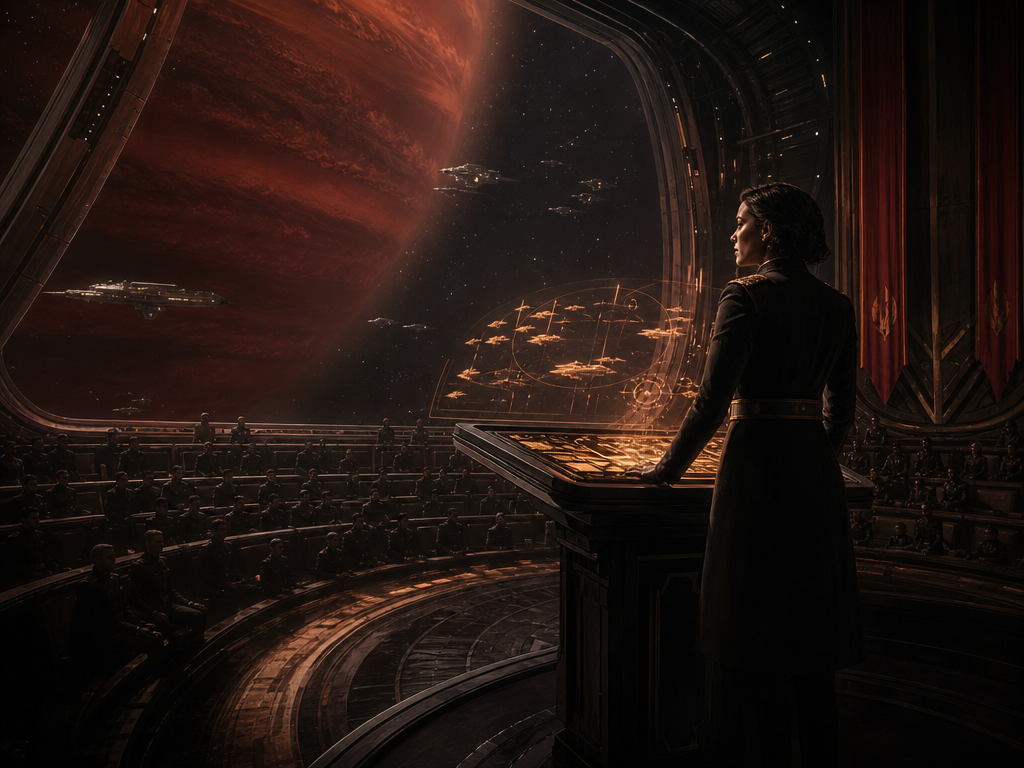
The Conclave chamber was a semicircle of tiered seats descending toward a central podium, designed for acoustic clarity in an era before neural interfaces. The Archon had always found it theatrical — a Roman senate dressed up as a military briefing room. But tradition held weight in the Dominion, and the High Conclave had been meeting in this chamber for six thousand years.
Twenty-three admirals filled the seats. The full Conclave — the senior fleet commanders, the intelligence chiefs, the colonial governors who held military rank by virtue of administering frontier systems. They had been woken at 0400 and assembled by 0430. The report was on their terminals. The Archon gave them ten minutes to read it.
The silence was worse than the shouting.
Admiral Tren spoke first. He was old — seventy-two, three campaigns behind him, a face like weathered stone. “He defied a direct withdrawal order.”
“He held position,” the Archon said. “There is a difference.”
“The difference is that Protocol means nothing if admirals can ignore it when they feel like it.” Tren’s voice carried the particular flatness of someone stating what he believed to be obvious. “If Vasari can hold position against a withdrawal order, then any admiral can hold position against any order. The chain of command becomes a suggestion.”
“The chain of command is intact,” the Archon said. “Vasari reported his actions. He is requesting guidance. He did not go silent.”
“After defying Protocol.” Admiral Korr leaned forward. She was younger than Tren, sharper, the kind of officer who saw every situation as a tactical problem. “The question is not whether he defied Protocol. The question is what we do about it. Recall him. Replace him with someone who follows orders.”
“And tell the Vael that our commander was pulled back for insubordination,” Dax said from his seat at the Archon’s right. “That’s the signal we send. That the Dominion fractures under pressure.”
“The Dominion fractures when admirals pick and choose which orders to follow,” Tren shot back.
The Archon let them argue. She had learned long ago that the Conclave needed to exhaust itself before it could think. The shouting was not chaos — it was the Dominion’s immune response, the system processing a shock it had no protocol for.
She watched them. Twenty-three faces, each one carrying the weight of a career spent in the Dominion’s service. They had trained for this — for first contact, for the possibility of encountering sapient life. But training was abstract. The reports from the Corridor were not. Twelve thousand ships. A bridge-mind who dreamed of gravity. An Upload that promised immortality. A resource assessment that suggested the gift came with a price.
The Archon had read Kael’s report four times. She had read the Vael diplomatic composition. She had read Nexus-7’s private channel message — the one Kael had included as evidence of the Vael’s internal division. Each reading had surfaced new gaps, new implications, new weight.
She raised her hand. The chamber quieted.
“We are not deciding Vasari’s fate today,” she said. “We are deciding how the Dominion responds to the first confirmed contact with an alien civilization in twelve thousand years of expansion.” She paused. “That is a larger question than one admiral’s judgment.”
“His judgment is the question,” Korr said. “He held when he should have withdrawn. He opened a channel when he should have maintained silence. He received intelligence about the Vael’s true purpose and included it in his report instead of following Protocol.” She looked at the Archon. “If that’s not a recallable offense, what is?”
The Archon held her gaze. Korr was right — by the letter of Protocol, Kael’s actions were indefensible. He had defied orders, opened unauthorized channels, and made independent decisions about intelligence that should have been routed through Fort Halo. Any one of those was grounds for removal.
But Protocol had been written for a different universe. A universe where first contact meant a single ship, a single signal, a cautious exchange. Not this — not twelve thousand ships emerging from the void, not a bridge-mind who carried truth across the gap between civilizations, not an offer that challenged the Dominion’s fundamental assumptions about what it meant to be human.
“The Protocol was written for contact,” the Archon said. “Not for this.”
“This is contact,” Tren said.
“This is contact with a civilization that can cross four hundred light-years of void, that has been watching our signals for centuries, and that is offering us something we do not have a framework to evaluate.” The Archon leaned forward. “The Protocol assumes we are the advanced party. We are not.”
The chamber went still. The admirals looked at her. She had said what none of them wanted to hear — that the Dominion, for all its forty thousand systems and twelve thousand years of expansion, was the junior party in this encounter.
Dax stood. He had been silent through the exchange, his jaw tight, his prosthetic arm resting on the armrest. The Archon recognized the posture — it was the same one he had worn before every campaign briefing, the stillness of a man organizing his argument.
“The question is not whether Vasari followed Protocol,” Dax said. His voice was low, controlled. “The question is whether Protocol is adequate.”
He let the words settle. The admirals looked at him.
“The Vael are here. Twelve thousand ships. A resource assessment that suggests they need what we have. An Upload offer that, if accepted, would dissolve the boundary between biological and digital life.” He looked at the Archon. “We can recall Vasari. We can replace him with an officer who follows orders. And then we can wait for the Vael to decide what happens next — on their terms, at their pace, with their twelve thousand ships.”
“You’re advocating for a preemptive posture,” Korr said.
“I’m advocating for readiness.” Dax’s prosthetic arm clicked against the armrest — an involuntary habit, the ghost of a reflex his nervous system had not discarded. “The Vael crossed the void because they need something. The resource assessment confirms it. If we recall Vasari and pull back to a defensive posture, we lose the tactical advantage he established by holding position. We lose the intelligence he gathered through direct engagement. And we signal to the Vael that the Dominion’s chain of command can be disrupted by the appearance of a foreign fleet.”
“The Dominion does not fire first,” the Archon said.
The words landed with the weight of twelve thousand years of doctrine. The chamber was silent.
Dax looked at her. His expression was unreadable — the particular blankness of a man who had spent thirty years in the Navy and learned to hide his thoughts behind professional courtesy.
“I am not advocating for a preemptive strike, Archon. I am advocating for a fleet posture that communicates strength while we determine the Vael’s intentions.” A beat. “There is a difference.”
“There is,” the Archon agreed. “And I will determine the fleet posture when I have more than eleven hours of delayed intelligence and a report from an admiral who defied his orders.”
She stood. The Conclave rose with her — a reflexive courtesy, the muscle memory of hierarchy.
“We will reconvene in six hours,” the Archon said. “I want updated sensor data from the Corridor. I want the intelligence staff to analyze the Vael diplomatic composition for inconsistencies. And I want a communication sent to Vasari — not a recall order, not a reinforcement directive. A request for elaboration.” She paused. “He held his position. He opened a channel. He gathered intelligence. Now he will explain his reasoning in full, with supporting data, and I will decide what the Dominion does with it.”
She left the chamber. The admirals remained, their voices rising behind her — the argument resuming, the factions hardening, the Conclave doing what it had always done: processing shock through debate.
The Archon returned to her quarters. The brown dwarf glowed beyond the viewport — dim, constant, the kind of light that did not change across millennia. Fort Halo had orbited this dwarf for eight thousand years. The station’s hull was scarred by micrometeorite impacts, its relay arrays reaching out across the void like fingers that never closed.
She sat at her desk. She opened Kael’s report again.
The sensor logs were precise. The communication transcripts were complete. The Vael fleet’s formation — twelve thousand ships, no hierarchical structure, energy signatures that did not match any known propulsion system — was documented with the thoroughness she expected from Kael. He was a careful officer. A precise one. The kind of man who followed Protocol until Protocol failed, and then made his own.
She read the section about Nexus-7. The bridge-mind who dreamed of gravity. Who had crossed the gap between civilizations to tell the truth. Who had been restricted by the Archivist for doing exactly what Kael had done — choosing individual judgment over institutional caution.
The Archon thought about her own line. Will never order a preemptive strike — the Dominion does not fire first, regardless of provocation. She had written that line twelve years ago, when she was elected Archon. It was not a policy. It was a principle — the foundation of everything the Dominion claimed to be.
But Dax was not wrong. The Vael had crossed the void because they needed something. The resource assessment confirmed it. And the Upload — the gift, the transition, the dissolution of the boundary between flesh and data — was real. Kael’s report made that clear. Nexus-7’s private channel made it clearer.
The Dominion’s First Contact Protocol assumed that first contact was a single event — a signal, a response, a cautious exchange. It did not account for the possibility that the other party would arrive in force, that the exchange would be ongoing, that the truth would emerge in layers rather than in a single transmission.
She opened a new channel. Not to the Conclave. Not to Dax. To the relay network — the vast web of arrays and stations that connected Fort Halo to every fleet in the Dominion.
She composed a message. Not a recall order. Not a reinforcement directive. A request for elaboration, addressed to Admiral Kael Vasari, Convergence Corridor.
She paused before sending it. The relay’s hum filled the room — constant, steady, the vibration of a network that had carried the Dominion’s voice across forty thousand systems for twelve thousand years.
She hit send.
The message would take eleven hours to reach the Corridor. Kael would receive it on Day 4 — by which time the Vael would have made another move, the Conclave would have hardened its factions, and the distance between Fort Halo and the front line would have grown by another eleven hours of light.
The Archon sat in the dark and watched the brown dwarf’s glow through the viewport. Somewhere in the Convergence Corridor, Kael was holding his position. Somewhere in the Vael Armada, Nexus-7 was dreaming of gravity. And somewhere in the gap between them, the truth was accumulating — layer upon layer, revelation upon revelation, each one heavier than the last.
She had twelve hours to decide what the Dominion would become.